Key takeaways
- A bookkeeping engagement letter is the contract you and a client sign before work starts. It turns what you agreed into things you can both check each month. That's what you do and by when, what the client sends and by when, what it costs, and what isn't included.
- Put a number on every service and list what's not included. In our example, the client has five employees, and payroll sits on the not-included list because nobody agreed to it.
- Tie your dates to the client's: reports by the 15th if records arrive by the 5th. Late records move delivery back by the same number of days, and a date on a weekend moves to the next business day.
- Write every price in before the first invoice. In our example, a 330-transaction month costs $725 + 2 × $40 = $805. The first charge is $725 + $500 setup = $1,225. The $2,250 catch-up is paid as the proposal said: $1,125 when Maria signs and $1,125 when the books are current.
- The builder writes three kinds of letter. A cleanup letter ends when the cleanup is delivered, and an hourly letter carries an estimate that is not a cap. The whole-agreement clause replaces the proposal, so anything the proposal promised needs its own line. The builder has fields for your reply time, a review call and how often the books are updated.
What is a bookkeeping engagement letter?
In short: The contract you and a client sign before work starts. It turns what you agreed into things you can both check each month. That's what you do and by when, what the client sends and by when, what it costs, and what isn't included.
Some call it a letter of engagement, or a bookkeeper engagement letter. In the r/Bookkeeping posts we read, bookkeepers mostly call it the contract.
Both of you sign it before work starts. Months later, the client asks why payroll isn't done, or why the November reports are late. The letter is the page you both read for the answer.
Why do bookkeepers need one?
CAMICO, which insures accounting firms, calls a signed letter "the first line of defense" against claims (CAMICO).
What can happen without one? An April 2026 Journal of Accountancy article gives a case. A CNA risk control director describes a firm that did accounting, tax, and payroll work for a brewpub with "no engagement letters".
A payroll audit under a local ordinance found violations. The client sued the firm for nearly $1 million, and the claim was resolved for several hundred thousand dollars (Journal of Accountancy, 2026).
It's one insurer's case. But the firm had nothing in writing about which payroll work it had agreed to do. In our view the same goes for a friend's business or a small job: the letter can be shorter, but it's still the record.
Is a bookkeeping engagement letter legally binding?
Once both sides sign, it generally works as a contract. How a court reads a clause depends on your state's law. That's why the builder asks for the governing state and county.
Engagement letter vs. proposal vs. service agreement
| Proposal | Engagement letter | Service agreement | |
|---|---|---|---|
| When | After the first call | After the yes, before work | Instead of the letter, for formal work |
| Holds | The price and what it's based on | Scope, dates, fees, terms | A numbered contract |
| Builder | Proposal template | This page | Service agreement template |
What should a bookkeeping engagement letter include?
In short: Eight parts in the letter, plus a page of standard terms. Most bookkeepers know the list, so use it as a check.
The eight parts are the parties and the term, the services with numbers, what's not included, the client's responsibilities with dates, your timeline, the fees, how the services change, and signatures from someone who can sign for the business. Each one is filled in, with a note, in the complete sample letter below.
The standard terms hold what stays the same for every client. That's payment, pausing work, reliance on the client's information, ending the engagement, records, confidentiality, dates on weekends, and the legal clauses. The builder puts them at the end, so the letter itself stays short enough to read.
The builder also opens the letter with a summary table, because that's the part a client is most likely to read before signing. The Journal of Accountancy article makes the same suggestion for the fees. It says "the use of a table is suggested for a cleaner presentation" (Journal of Accountancy, 2026).
The table repeats the numbers from the sections below it and adds no new terms, so the two can't disagree.
How to write a bookkeeping engagement letter, step by step
In short: Start from the accepted proposal. The builder carries most of it over, so your work is checking a few things and filling in the terms only the letter has.
This guide's example client is Maria Lopez, who owns Lopez Cleaning Co, a cleaning company with five employees. She accepted the Growth package in the proposal from Northline Bookkeeping, a sample firm owned by Jordan Miles. Create engagement letter under the proposal builder carries her details into the builder above: the client, the $725 fee, and the scope. It also carries the start date (October 26, 2026) and the one-time fees ($2,250 catch-up, $500 setup).
To see the result without a proposal, click See the guide's example filled in in the builder. Then work down the panel:
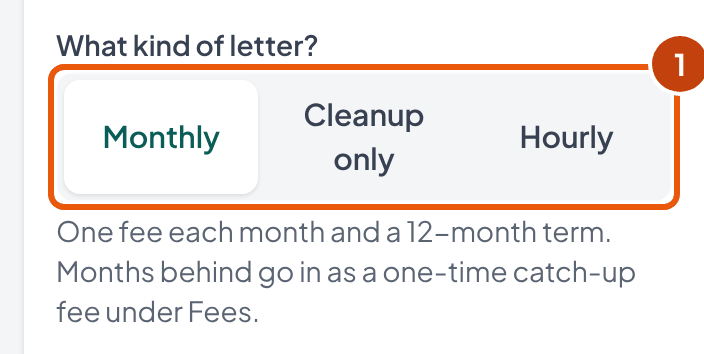
- Letter type: keep Monthly. For a cleanup with no monthly work after it, or for hourly work, switch the builder. The versions section explains what changes.
- Client: change the business name to the registered one. The proposal said Lopez Cleaning Co; the letter says Lopez Cleaning Co LLC.
- Scope and services: tick only what you agreed. Growth ticks accounts payable, invoicing, and the cash flow report. Payroll stays unticked and lands on the not-included list, even though Maria has five employees.
- Fees: check that the one-time fees came across. With 5 months behind, the letter names the catch-up months (June through October 2026), says when the catch-up is done, and dates the first reports December 15, the same date as the proposal.
- Terms: fill in the state and county (Illinois and Sangamon here). They're the only required fields a proposal can't supply.
- Support promises: set your reply time, the review call and how often the books are updated under Scope and services, to match the proposal's package. Otherwise the whole-agreement clause drops them (see Which promises can you keep?).
- Checks box: read it before you download or send. It flags a records day on or after the reconciliation day, a day past the 28th, a catch-up fee with 0 months behind, and payroll ticked with no provider named.
No proposal? Type the numbers in. The monthly fee in the builder is only an example, and the pricing template works one out from your hourly rate.
A complete sample bookkeeping engagement letter, with notes
In short: Here is the full letter the builder writes for the guide's example client, every clause included. The notes beside it say what each part does, what it protects you from, and where the rule comes from.
Northline Bookkeeping and Lopez Cleaning Co LLC are fictional, and so are the people, addresses, and figures. The text is the builder's own. Load the example in the builder above, and you'll see the same letter and can change any number in it.
Northline Bookkeeping
812 Monroe Street, Springfield, IL 62704 · (555) 010-0142 · [email protected]
October 12, 2026
Maria Lopez
Lopez Cleaning Co LLC
44 Prairie Avenue, Springfield, IL 62702
Re: Engagement Letter for Bookkeeping Services
Dear Maria Lopez,
Thank you for choosing Northline Bookkeeping. This letter sets out what we agreed: what we will do, what we won't do, what we need from you, and what it costs. The table below sums it up, and the Standard Terms and Conditions at the end are part of this agreement.
| What's included | Up to 250 transactions a month, reconciling 2 bank accounts and 1 credit card account, and a monthly Profit & Loss and Balance Sheet, plus entering bills (accounts payable), sending invoices (accounts receivable), and a cash flow report |
|---|---|
| One-time work | Catch-up for the 5 months your books are behind ($2,250); setup of your file ($500) |
| What's not included | Tax returns, paying bills, payroll, sales tax filing, Forms 1099, audits, legal advice, and searching for fraud |
| What we need from you | Statements and receipts by the 5th of each month, and answers to our questions within 2 business days |
| When you get reports | By the 15th of each month, for the month before, if your records arrive on time; replies to your questions within 2 business days |
| What it costs | $725 a month, plus $40 for each 50 transactions (or part of 50) over 250 in a month |
| Term | October 26, 2026 to October 25, 2027. About a month before it ends, we'll send you a new letter for the next year. |
| Ending early | Either of us can end it with 30 days' written notice |
1. Parties and term
This engagement is between Northline Bookkeeping ("we" or "us") and Lopez Cleaning Co LLC ("you"). It begins on October 26, 2026 and ends on October 25, 2027. About a month before it ends, we will send you a new letter to sign.
2. Services we will provide
Each month, we will:
- Record and categorize up to 250 transactions from 2 bank accounts and 1 credit card account
- Reconcile those accounts to your statements by the 10th of the following month
- Prepare a Profit & Loss Statement and Balance Sheet on a cash basis
- Update your books twice a month
- Hold a review call with you each quarter
- Enter your vendor bills and track what you owe (accounts payable)
- Create your customer invoices and track who owes you money (accounts receivable)
- Prepare a monthly cash flow report
- After December is reconciled, send your tax preparer the year's reports, give them access to the file, and post the adjusting entries they send us
Before the monthly work begins, we will also:
- Bring your books up to date for the 5 months before the monthly work starts in November 2026, June 2026 through October 2026 (catch-up)
- Set up your file and our access to it (setup)
The catch-up is done when each account listed above is reconciled to its statement through October 31, 2026 and you have the reports for those months. We start from the balances on your last filed tax return, and we won't change a filed year without your written approval after you tell your tax preparer. If the catch-up needs more months or accounts than this letter lists, we will stop and get your written approval before doing that work.
We will work in QuickBooks Online, and you will give us accountant access to the file. You pay for the software subscription, including any price increases, unless we agree otherwise in writing.
3. Services not included
This engagement does not include tax return preparation or tax planning, paying bills, payroll, sales tax filing, Forms 1099, CPA reports on your financial statements (audits, reviews, or compilations), legal or financial advice, representing you before the IRS or a state tax agency, or bookkeeping for months before the 5 months of catch-up in Section 2. If you need any of these, we can quote them separately.
4. Your responsibilities
So we can meet the dates in this letter, you agree to:
- Send bank and credit card statements, receipts, and invoices by the 5th of each month
- Answer our questions within 2 business days
- Keep our software access active, and tell us when you open a new bank or credit card account
- Use separate bank and credit card accounts for the business, and tell us about personal transactions that go through them
- Keep the receipts and other support for your expenses, and decide with your tax preparer how personal or unclear items are treated. We record them as you instruct in writing
- Review the reports we send and tell us about anything that looks wrong before your next month's records are due
- Tell us before you or your staff change or delete entries in a month we have already closed
You are responsible for your business decisions, your internal controls, and the accuracy and completeness of the information you give us.
5. Timeline
We will deliver monthly reports by the 15th of each month, for the month before, provided we receive your records by the 5th and your answers within 2 business days. If your records or answers arrive late, delivery moves back by the same number of days. We reply to your questions within 2 business days. We will finish the catch-up and deliver your first monthly reports, for November 2026, by December 15, 2026.
6. Fees
- Monthly fee: $725, due on the 1st of each month.
- Setup fee: $500, due once, with the first monthly fee.
- Catch-up fee: $2,250, once, for the months in Section 2. Half, $1,125, is due when you sign, and $1,125 when the books are current.
- Transactions over 250 a month: $40 for each additional 50 transactions or part of 50. If you go over 250 transactions three months in a row, or add bank accounts, businesses, or employees, we will propose a new monthly fee before anything changes.
- Fixed-price add-ons (only when you ask for them in writing): each additional bank or credit card account $35 a month; Forms 1099 $75 for up to three recipients and $15 for each additional recipient; sales tax filing $150 per return.
- Other work not listed in Section 2: $65 an hour, only with your written approval (see Section 7).
Our fees don't depend on the results of our work. Apart from the changes described above, we review fees once a year, when we send the new letter.
7. Changes to the services
We will do work not listed in Section 2 only after you approve it in writing (email is fine), at a price agreed in advance. If we add or remove a monthly service, we will both sign an updated letter or a short written amendment. Correcting entries that you or your staff change in a month we have already closed, and time spent on software or bank-feed problems, are work not listed in Section 2. Training a new bookkeeper, or answering questions after the engagement ends, is work not listed in Section 2.
8. Acceptance
If this letter reflects our agreement, please sign below and return a copy. We will begin work once we receive the signed letter.
Sincerely,
______________________________
Jordan Miles, Owner
Northline Bookkeeping
Accepted and agreed (authorized signer):
______________________________
Maria Lopez, Owner
Lopez Cleaning Co LLC
Date: ________________
Standard Terms and Conditions
1. Payment. The monthly fee is due on the 1st of each month, and one-time fees when Section 6 says. You may pay by credit card or bank transfer (ACH). If an amount is still unpaid 15 days after its due date, you pay a late fee of $25 for that payment, or the highest amount the law allows if that is lower.
2. Pausing work. If an amount is still unpaid after 30 days, or records we asked for are still missing after 60 days, we may pause our work until you pay or send them. We will tell you in writing before we pause. We are not responsible for delays caused by the pause.
3. Reliance on your information. Our work is based on the information you give us. We do not audit or verify it, and you can't rely on our work to find errors, fraud, theft, or other illegal acts.
4. False or misleading entries. We record transactions as they happened. We won't record anything we believe is false or hides income. If you ask us to record such an entry, we may end this engagement at once, without the notice in the next term.
5. Ending the engagement. Either of us may end this engagement with 30 days' written notice. You pay for the work we did up to the end date.
6. Records. We will return the records you gave us (statements, receipts, and other source documents) within 45 days of your request, even if an amount is unpaid. We will deliver the reports and reconciliations we prepared once you have paid for that work. Your accounting software file belongs to you. When the engagement ends, we will remove our access and, if we hold the primary admin role, transfer it to you. We keep our own working files for 7 years.
7. Confidentiality and data security. We will keep your financial information confidential and use it only to provide these services, unless the law requires us to disclose it. We use tools such as cloud accounting software, a document portal, and e-signature software. You are responsible for protecting your own passwords. If we learn that someone got unauthorized access to your data that we hold, we will tell you promptly.
8. Other companies' software and subcontractors. We may use software made by other companies and, where needed, subcontractors who have agreed to keep your information confidential. We are not responsible for outages or errors in other companies' software.
9. Legal proceedings. If a subpoena or other legal process requires us to produce documents or testify about your matters in a case we are not a party to, you agree to pay for our time at our hourly rate for other work ($65) and for reasonable expenses, including legal fees.
10. Disputes. We will first try to resolve any dispute by discussing it in good faith. If that fails, we will take it to mediation.
11. Governing law. This agreement is governed by the laws of the State of Illinois, with venue in Sangamon County.
12. Dates. If a date in this letter falls on a Saturday, Sunday, or a federal holiday, the next business day applies.
13. Electronic signatures and copies. Either of us may sign this letter electronically, and each of us may sign a separate copy. Each signed copy counts as an original, and together they form one agreement.
14. General. This letter and these terms are our whole agreement about these services. They replace any earlier proposal or discussion. If a court finds any part unenforceable, the rest still applies. Sections 1, 3, 6, 7, 9, and 10 of these terms still apply after the engagement ends. Notices, such as notice to end the engagement, must be in writing (email is fine).
Three optional clauses are off in this letter: limitation of liability, indemnification, and arbitration for fee disputes. The legal terms section explains when to turn them on.
How do you write the scope so it has limits?
In short: Put a number on every service and list what's not included. Then the boundary is drawn on both sides.
"We'll handle your bookkeeping" sets no limit. A client can reasonably read it as payroll, sales tax, and a tax return.
"Record and categorize up to 250 transactions from 2 bank accounts and 1 credit card account" can be checked at the end of every month. So can the reconciliation date and the reports.
The Journal of Accountancy article gives a test for it. An independent party "should be able to read the scope of services and understand exactly what you will provide" (Journal of Accountancy, 2026).
Section 2 of the sample letter is the whole list for Maria. Reconciling by the 10th means matching each account to its statement; the balance sheet reconciliation template shows what that proof looks like for the other accounts on the balance sheet. The services you tick, such as accounts payable or the cash flow report, are added to the list in the client's words.
What goes on the not-included list?
Everything a client could reasonably assume is part of bookkeeping and isn't. For Maria, payroll comes first. She has five employees, and payroll wasn't in the Growth package. A client who hears "bookkeeping" and "employees" in the same conversation may assume it's covered.
The builder lists every service you leave unticked, including paying bills: a client who sees "accounts payable" can read it as paying them too. It adds tax returns, CPA reports on financial statements, legal or financial advice, and representation before the IRS or a state tax agency.
Some clients need a boundary of their own. For a law firm it's the client trust account: who approves payments, who signs checks, and who reconciles. Law firm bookkeeping has sample wording.
Taking one on? The sales tax reconciliation helps with sales tax filing, the accrued payroll entry with payroll at month end, and the 1099 watch in the accounts payable template with Forms 1099.
| Leaves the boundary open | Draws it |
|---|---|
| Full-service bookkeeping | Up to 250 transactions a month from the 2 bank accounts and 1 credit card account listed above |
| Payroll support as needed | This engagement does not include payroll. If you need it, we can quote it separately. |
| We'll keep your books tax-ready | This engagement does not include tax return preparation or tax planning. |
In the r/Bookkeeping threads we read, posters describe three lines that letters often leave out, and the builder now writes all three:
- no payment leaves the client's accounts without the client's approval (the Pay approved bills service, when you tick it, says so and adds a rule for new payees and changed bank details)
- receipts and other support for expenses are the client's to keep, and unclear items are recorded the way the client instructs in writing (Section 4, in every letter)
- at year end, the tax preparer gets the year's reports, and the bookkeeper posts the adjustments the accountant sends back (Section 2 of the monthly and hourly letters)
Those are individual posts, not a survey, and the wording is ours. Remove a line with Edit text freely if it doesn't fit the client.
The bill pay line
Schedule payment of the vendor bills you approve in your bill pay tool. Each payment goes out only after you approve it, and we won't add a payee or change a payee's bank details without your written approval, confirmed by phone.
In the builder: Scope and services: tick Pay approved bills. Open the builder ↑
Payroll, with the numbers
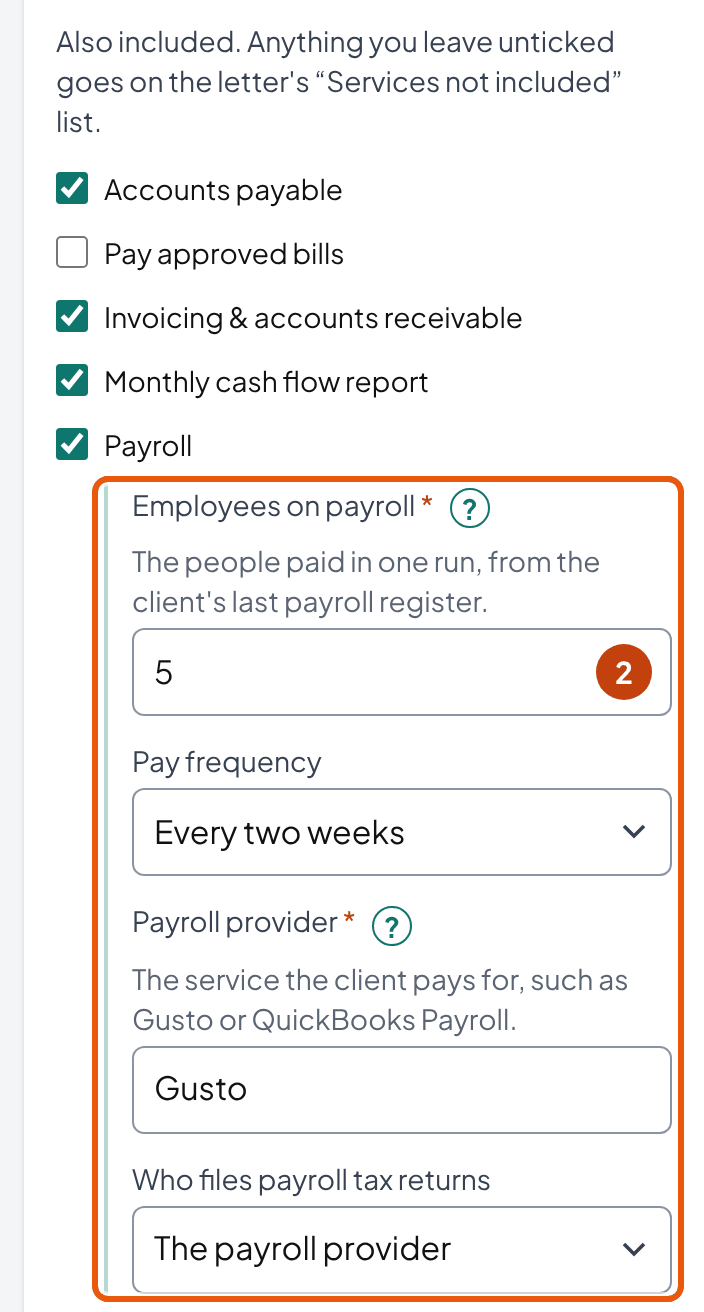
If you do run payroll, say for how many people, how often, through which provider, and who files the payroll tax returns.
When you tick Payroll, the builder asks for those four details and writes them into the services. The letter then says "run payroll for your 5 employees every two weeks through Gusto" instead of "payroll". The CNA claim above started with a payroll audit, so this is the service where a vague line costs the most.
Sample wording
Run payroll for your 5 employees every two weeks through Gusto, using the hours and pay changes you approve before each pay date. Gusto files the payroll tax returns and deposits; we check that each filing matches the payroll we ran.
In the builder: Scope and services, under the Payroll checkbox. Gusto is an example; name the client's provider. Open the builder ↑
What happens when the client asks for more?
Section 7 of the letter answers that. You do work that isn't listed only after the client approves it in writing, at a price agreed in advance. An email is enough.
So when Maria asks in March whether you can also run payroll, the answer is a quote rather than a favor. Her reply to the quote is the record. For a change to the monthly services, sign an updated letter or a short amendment (wording below).
How do you tie your deadlines to the client's?
In short: Put a date on each thing the client sends, and make each of your dates depend on it. Late records then move your delivery instead of breaking it.
A delivery date on its own is a promise you can miss through no fault of your own. So the builder writes the client's dates first: statements and receipts by the 5th, answers within 2 business days.
Then it writes yours: reconciliations by the 10th and reports by the 15th, provided the client's dates are met. If the records or answers arrive late, delivery moves back by the same number of days.
| Start date (from the proposal) | October 26, 2026 |
| Work starts October 26, so the first full month is | November 2026 |
| November statements and receipts due | December 5 |
| Reconciliations done by | December 10 |
| First monthly reports, for November, by | December 15 |
| If Maria sends November's records four days late, reports are due by | December 19 |
The builder dates the first reports with the same rule as the proposal builder, so the proposal and the letter both say December 15. (December 5 and December 19, 2026 are a Saturday; the next section says what the letter does about that.)
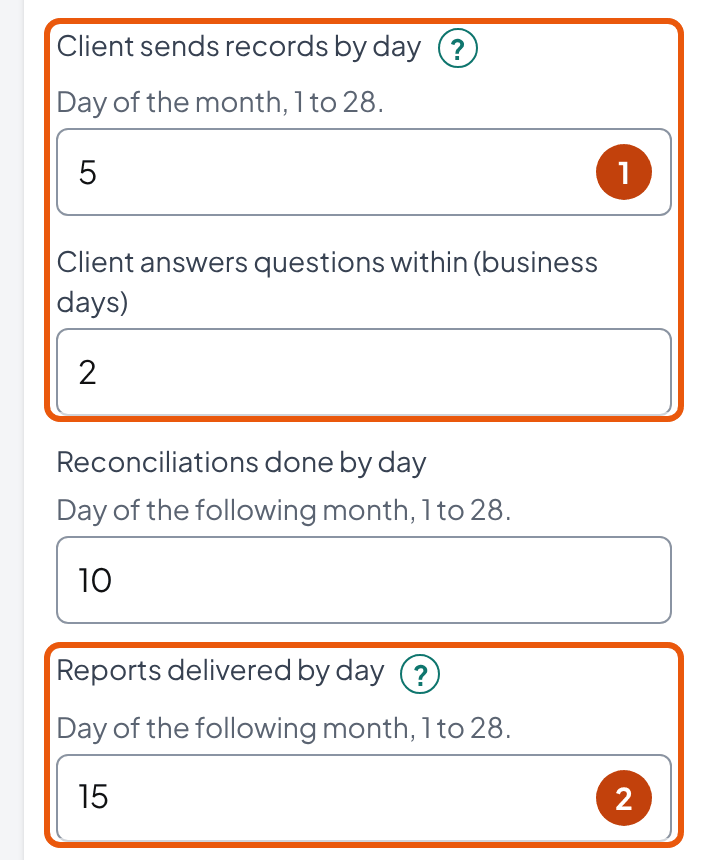
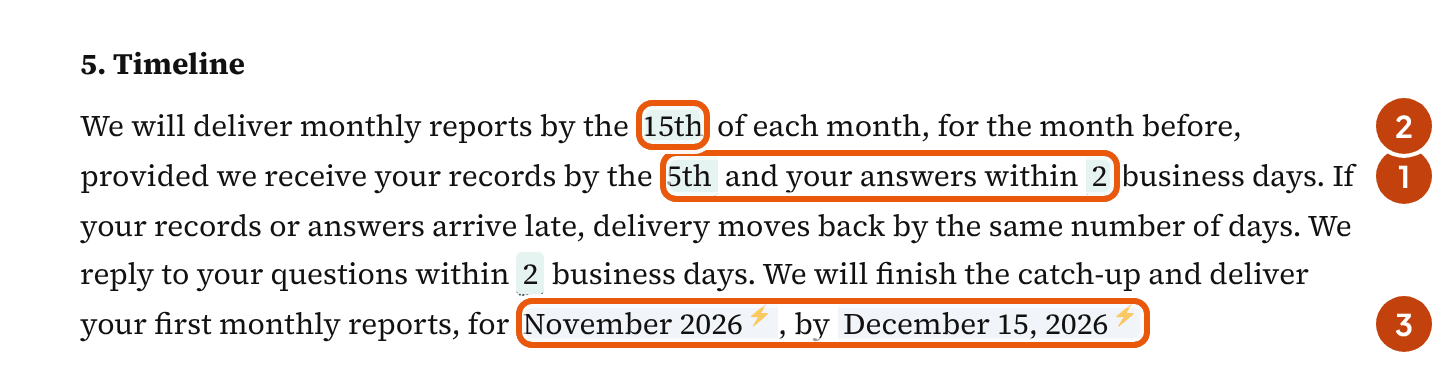
The full wording is Section 5 of the sample letter. It also carries your own promise, a reply within 2 business days, from the You reply to the client within field. The line above it, the client's 2 days to answer you, is a different promise.
Bookkeeper tip: Keep every day between 1 and 28, so it exists in February. The Checks box under the letter flags a day past the 28th, and a records day that isn't before the reconciliation day.
What if a date falls on a weekend or a holiday?
Day-of-month dates land on weekends about two months in seven, since 2 of every 7 days are a weekend. A letter that doesn't say what happens then leaves both of you guessing.
The builder's standard terms include one sentence for it. It reads: "If a date in this letter falls on a Saturday, Sunday, or a federal holiday, the next business day applies." It's our wording, not a legal requirement, and it works in the client's favor and yours alike.
| November 1, 2026, the first charge date, is a Sunday, so the $1,225 is due on | Monday, November 2 |
| December 5, 2026, when November's records are due, is a Saturday, so they're due | Monday, December 7 |
| December 10 (reconciliations) and December 15 (reports) are a Thursday and a Tuesday | unchanged |
| Records sent four days after December 7, on December 11, move the reports four days, to | December 19 |
| December 19 is a Saturday, so the reports are due | Monday, December 21 |
Without the sentence, a client could argue that records sent on Monday the 7th were two days late. With it, they were on time.
How should the letter set out fees?
In short: Write out every price the client could be charged before the first invoice: the monthly fee, one-time fees, extra transactions, add-ons, and an hourly rate for anything else.
A price that isn't in the letter becomes a negotiation when it comes up, and usually a discount. The builder's Fees section lists each one. It makes the monthly fee due on the 1st and names card or bank transfer (ACH) as the ways to pay. It also says the fees don't depend on the results of the work.
How the overage works
The monthly fee covers up to 250 transactions. Each block of 50 over that, or part of a block, costs $40. That's the builder's example price, about 0.6 hours at the proposal builder's $65 hourly rate, which is our assumption, not a market rate.
| Transactions in March | 330 |
| Over the 250 in the fee: 330 − 250 | 80 |
| Blocks of 50, counting the part block: 50 + 30 | 2 |
| Overage: 2 × $40 | $80 |
| March total: $725 + $80 | $805 |
If she stays over 250 for three months in a row, the letter says you'll propose a new monthly fee before anything changes. For comparison, the proposal builder prices Growth at 330 transactions at $825 a month, close to paying the overage every month.
Catch-up and setup as one-time fees
Catch-up ends, so it doesn't belong in the monthly fee, and the letter names the months it covers. Enter the months behind and the catch-up fee under Fees.
Maria's catch-up is 5 months at the proposal's Essentials fee: 5 × $450 = $2,250. The proposal builder prices catch-up at the full package 1 fee for each month behind. That's close to the "months behind × the monthly fee" frame bookkeepers describe in the r/Bookkeeping threads we read. Those are individual posts, not a survey, and the letter takes whatever price you enter.
The builder then adds a line in the summary table and a catch-up fee line in Section 6. A "before the monthly work begins" item names the months: June through October 2026, ending the month before the monthly work starts in November 2026.
The fee line repeats the proposal's payment terms, word for word: "Half, $1,125, is due when you sign, and $1,125 when the books are current." Create engagement letter carries the proposal's choice into When the catch-up is paid. That way the two documents can't disagree. Half up front is our starting assumption. In one r/Bookkeeping thread we read about pricing a cleanup, the most-upvoted pricing reply also asked for half up front; that's one thread, not a survey.
A paragraph under it says when the catch-up is done: each account reconciled through October 31, 2026, starting from the last filed tax return. It also puts a stop for written approval before more months or accounts. That wording is ours.
The not-included list then excludes only the months before the catch-up. With 0 months behind, catch-up stays on the not-included list. No monthly work after the cleanup at all? Use the cleanup-only letter instead.
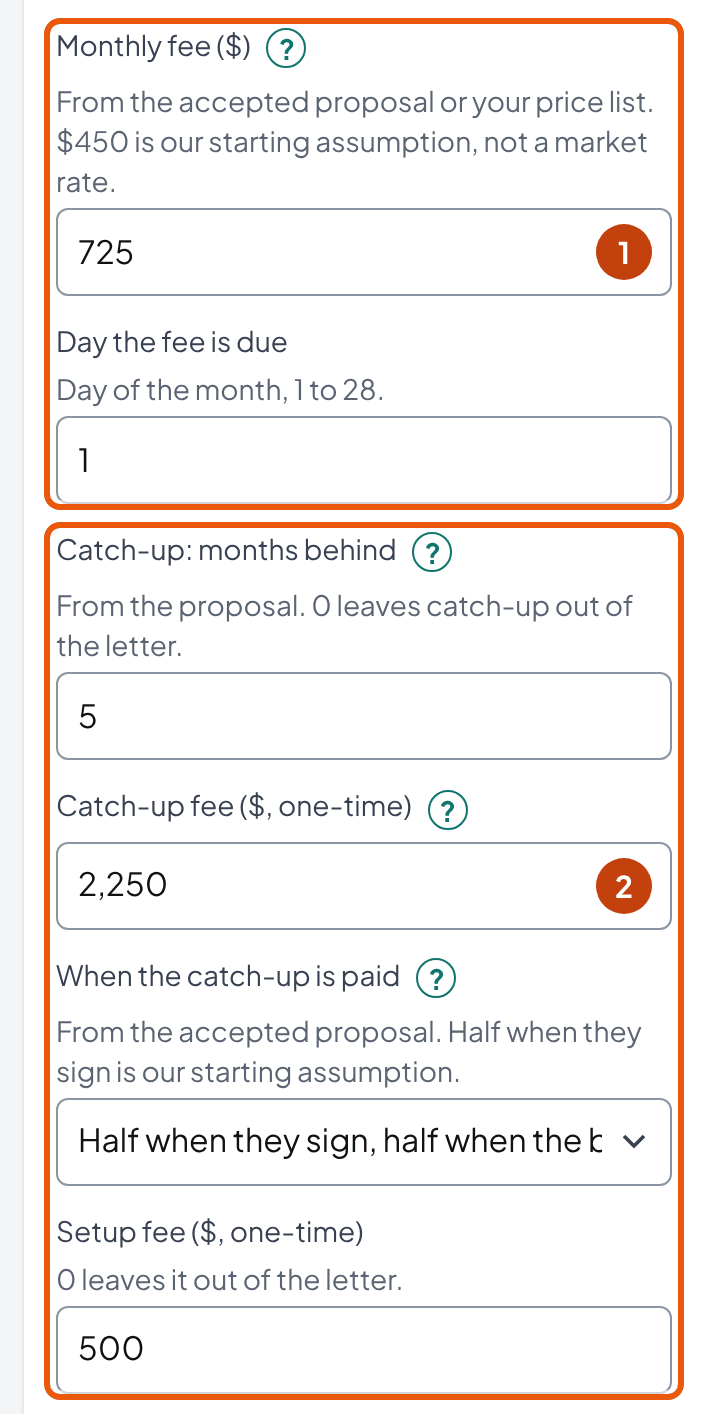
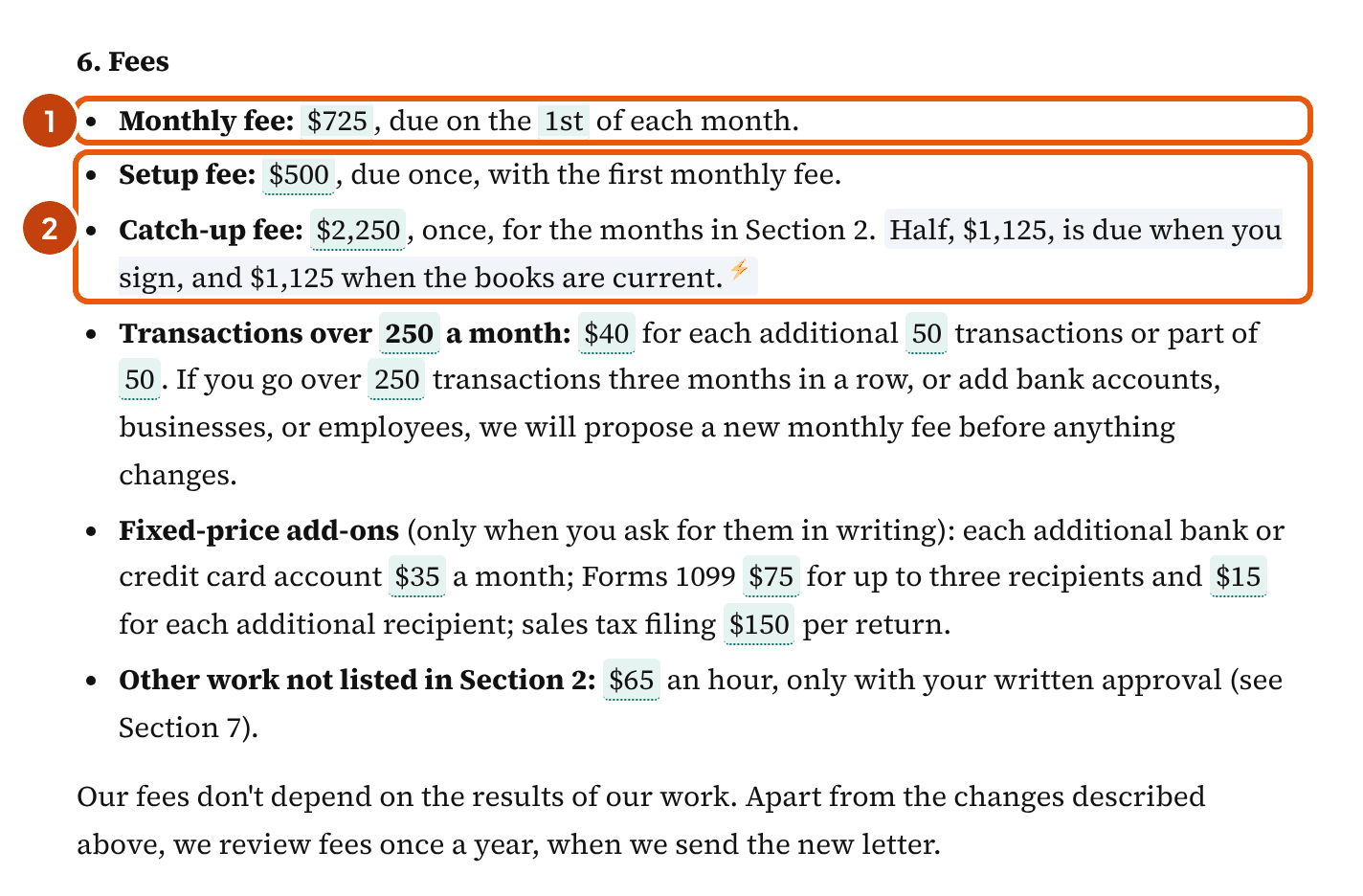
Maria pays $1,125 of the catch-up when she signs. The term starts on October 26, so the first 1st of the month is November 1. Her first charge is $725 + $500 setup = $1,225, on Monday, November 2, since the 1st is a Sunday. The other $1,125 is due when the books are current, by her first reports on December 15.
Would you rather collect the whole catch-up before you start? Choose All when they sign in the proposal, or under When the catch-up is paid here, and say so on the call too.
Add-ons, hourly work, and late payments
Add-ons have fixed prices and start only when the client asks in writing. Each extra bank or card account is $35 a month. Forms 1099 are $75 for up to three recipients and $15 for each one after that. Sales tax filing is $150 a return.
Those are the same defaults as the proposal and pricing builders, and all three are our example prices. Anything else is $65 an hour, again only with written approval.
For late payments, CAMICO advises firms to "avoid usurious interest charges" and to assess a late fee instead (CAMICO). So the builder starts with a flat fee: $25 once for each payment still unpaid 15 days after its due date. If the law allows less, the lower amount applies. The $25 is our starting assumption, not CAMICO's figure or a market rate, so enter your own amount under Late charge.
The other choice there is 1.5% a month, also our starting clause. It works like interest: on Maria's ordinary $725 month it's $10.88, and on her $1,225 first charge, $18.38, every month the amount stays unpaid.
Which promises can you keep in an engagement letter?
In short: Promise the process, not outcomes: dates and counts you control, such as reconciliations by the 10th, rather than "accurate books". Words like "all", "complete", and "verify" promise more than any bookkeeper can deliver.
CAMICO tells firms to limit the scope "by avoiding superlatives and absolutes such as all, every, any, complete, confirm, totally, validate and verify" (CAMICO). "Ensure", "guarantee", and "always" cause the same trouble.
The builder's monthly letter doesn't use them to describe your work. "Verify" appears once, in the sentence saying you don't.
| Can't be checked | Can be checked |
|---|---|
| We will ensure your books are accurate and complete. | We will reconcile your 2 bank accounts and 1 credit card account to your statements by the 10th of the following month. |
| We will verify all transactions. | We will record and categorize up to 250 transactions a month from the accounts listed above. |
| Timely monthly reports | Reports by the 15th of each month, for the month before, if your records arrive by the 5th. |
| We're always available when you need us. | We reply to your questions within 2 business days. |
Your work isn't an audit, so say so
The standard terms say your work is based on the information the client gives you, and that you don't audit or verify it. They also say the client can't rely on your work to find errors, fraud, theft, or other illegal acts.
CAMICO lists "reliance on facts provided by the client" among the things a letter should state. Without it, a client who later finds a theft can argue that a bookkeeper who reconciled the accounts every month should have caught it.
What the proposal promised
The Tax Adviser, published by the AICPA, makes the point for tax engagements. When a formal proposal comes first, it notes, "the engagement letter operates as an acceptance, with any changes noted, to the terms of the proposal" (The Tax Adviser, 2014).
The builder's letter handles this with a "whole agreement" clause: the letter and its terms replace any earlier proposal or discussion. That protects you from a stray line in a proposal. It also drops anything you meant to keep.
Carried into the letter by "Create engagement letter"
- Growth package: $725 a month
- 250 transactions, 2 bank accounts, 1 card account
- Accounts payable, invoicing, cash flow report
- Start October 26, 2026
- Catch-up $2,250, half when she signs, and setup $500
- Sales tax filing $150 a return, as an add-on
Dropped by the whole-agreement clause unless the letter has a line for it
- A support promise left blank in the letter's fields: the review call, how often the books are updated, your reply time
- Anything typed into the proposal's own text that no field carries
- Anything said on the call and never written down
The Growth package in Maria's proposal also promised a quarterly review call, books updated twice a month, and replies within 2 business days. The builder has a field for each, under Scope and services: Review call with the client, Books updated, and You reply to the client within. The guide's example sets them to Growth's promises, so Section 2 lists the call and the updates, and Section 5 the reply time.
Set them to what the proposal said, or tell the client before they sign that you've changed one. If you keep only one, keep the reply line: in the r/Bookkeeping threads we read, owners judge a bookkeeper by response time. Your reply time is a separate field from the client's time to answer you, so the two can't be confused.
How long should the letter last, and how does it end?
In short: Twelve months, then a new letter. In between, the letter says when you can pause work, how either side ends it, and what happens to the records.
When should you update an engagement letter?
At least once a year, and whenever the services or the fee change. CAMICO's advice is to "avoid evergreen letters" and "update letters annually" (CAMICO). The Journal of Accountancy article suggests limiting an engagement "to no more than one year" (Journal of Accountancy, 2026).
So the builder ends the letter 12 months after the start: Maria's runs from October 26, 2026 to October 25, 2027. The letter also says you'll send a new one about a month before it ends.
Between renewals, the same article lists three ways to record a change. You can sign an amendment. The client can confirm the change and its effect on services and fees by email. Or you keep a change log you review with the client.
Send a new letter or an amendment when you add or drop a service or your fee changes. Do the same when the client stays over the transaction limit, or adds a business, accounts, or locations.
Bookkeepers in the r/Bookkeeping threads we read give the same answer for a client who has outgrown the price. Re-scope in writing, with a new letter that lists what you now do, effective a date.
Wording for an amendment
An amendment is a short letter. It names the original, says what changes and from when, and says everything else stays. Both sides sign it.
For a renewal with a new fee, the builder's own letter is simpler. Change the start date and the fee and send the new letter; it replaces the old one on signing.
Sample amendment
Amendment to our engagement letter dated October 12, 2026
From April 1, 2027, the services in Section 2 also include running payroll for your 5 employees every two weeks through Gusto, using the hours and pay changes you approve before each pay date. Gusto files the payroll tax returns and deposits; we check that each filing matches the payroll we ran. The monthly fee in Section 6 changes from $725 to $875. Payroll is removed from Section 3. Everything else in the letter and its Standard Terms and Conditions stays the same.
Signed for Northline Bookkeeping: ______________ Date: ______
Accepted for Lopez Cleaning Co LLC: ______________ Date: ______
In the builder: There's no field for this; copy it into a short document. The $875 is an illustration, not a payroll price. Open the builder ↑
When can you pause work?
When fees are unpaid or records are missing for longer than the letter allows. CAMICO's list of what a letter should include has "a stop-work clause" on it.
The builder's version lets you pause after 30 days unpaid or 60 days of missing records. It requires you to tell the client in writing first.
| First charge due (November 1 is a Sunday, so the dates clause moves it) | Monday, November 2 |
| Amount: $725 + $500 setup (the catch-up's first half was due when she signed) | $1,225 |
| Late fee 15 days after the due date | November 17 |
| Late fee: the builder's flat fee, once for this payment | $25 |
| You may pause work after 30 days unpaid, after telling her in writing | December 2 |
The pause falls before her first reports are due on December 15, and the letter says you're not responsible for delays it causes. With 1.5% a month chosen instead, the late charge would be $18.38 a month on the $1,225.
Ending the engagement and returning records
Either side can end the engagement with 30 days' written notice, and the client pays for the work done up to the end date. The Journal of Accountancy article recommends stating when each side may end it, "including nonpayment of fees".
For records, the builder uses the 45 days from the AICPA's rule for CPAs (ET section 1.400.200). As The Tax Adviser summarized it, a CPA should return records "generally within 45 days after the request is made". In that summary, the CPA may hold back records it prepared when fees for that work are unpaid (The Tax Adviser, August 2014).
The 2021 revision says withholding client-provided records "is not permitted when responding to a client's initial request" (Journal of Accountancy, 2021).
The rule binds AICPA members (CPAs), not bookkeepers, so for most readers 45 days is our default, not their obligation. The service agreement builder uses the same 45 days. We haven't been able to read the current text of the rule itself.
The full wording is term 6 of the sample letter; the years for your working files are under Terms.
The 7 years is the builder's default for your own working files. For comparison, the IRS generally asks taxpayers to keep records for 3 years. It's 6 years if income was underreported by more than 25%, 7 for a bad debt or worthless securities, and 4 for employment tax records (IRS Topic 305).
Those periods apply to the client's tax records, not to a bookkeeper's files. So treat 7 as a choice that covers them, not a requirement.
What about help after the end? In the threads we read, bookkeepers treat training a replacement as separate paid work, beyond a basic handover (reports exported, access transferred). The builder's Section 7 says so: training a new bookkeeper, or answering questions after the engagement ends, is work not listed in Section 2. The client reads it before the last month, not after.
Which legal terms go in the standard terms?
In short: The ones that stay the same for every client. Three of them are off by default, because whether to use them depends on your insurer and your state.
The builder's standard terms cover:
- payment and late charges, pausing work, and ending the engagement
- reliance on the client's information, false or misleading entries, records, and confidentiality
- other companies' software and subcontractors (with an optional line on people outside the US), and costs if you're subpoenaed
- disputes, governing law, dates that fall on a weekend, and electronic signatures
- a "whole agreement" clause
The state and county are required, because a governing-law clause with a blank does nothing.
The false-entries term answers a question readers asked often: what happens when a client asks you to record something false. In the r/Bookkeeping threads we read, commenters advised pointing to the terms the client had signed, refusing in writing, and referring the client to their CPA. The term gives you something to point to, and lets you end the engagement at once, without the 30 days' notice. The wording is ours.
Who works on the file is the other question owners ask. The software and subcontractors term says subcontractors keep the client's information confidential. Under Terms, People outside the US adds one of two lines. One promises no access from outside the US without the client's written consent; the other says plainly that some of your team work outside the US. It's a choice we offer, not a legal requirement we've checked.
The client reads the terms too, so the builder writes them in plain words with the same meaning. A few examples of the change:
| Usual legal wording | The builder's wording |
|---|---|
| This letter may be signed in counterparts. | Each of us may sign a separate copy. Each signed copy counts as an original, and together they form one agreement. |
| Work products will be delivered once the fees for the related work are paid. | We will deliver the reports and reconciliations we prepared once you have paid for that work. |
| Our fees are not contingent on the results of our work. | Our fees don't depend on the results of our work. |
| Sections 1, 3 and 5 survive termination. | Sections 1, 3, and 5 of these terms still apply after the engagement ends. |
The optional clauses
Limitation of liability (capped at 12 months of fees, or at the fees paid under a cleanup letter), indemnification, and arbitration for fee disputes stay off until you tick them.
CAMICO's advice is to "evaluate the appropriateness and efficacy" of limitation of liability clauses rather than add them by default. It also suggests "mediation for all disputes and an arbitration clause for fee disputes only" (CAMICO). The builder always includes mediation; the arbitration line is the optional part.
Whether any of the three holds up differs by state. Check with your professional liability insurer or an attorney before you turn them on.
Are electronic signatures valid?
Generally, yes. The federal ESIGN Act says a contract "may not be denied legal effect, validity, or enforceability solely because an electronic signature or electronic record was used in its formation" (15 U.S.C. 7001).
Across the states, 49 have adopted the Uniform Electronic Transactions Act, and New York uses its own law (Adobe, a secondary source). The builder's letter says it may be signed electronically.
Do the Act's consumer consent steps apply? Not to a business client. The extra steps (15 U.S.C. 7001(c)) apply when a law requires information to be given "to a consumer in writing". A consumer is "an individual who obtains, through a transaction, products or services which are used primarily for personal, family, or household purposes" (15 U.S.C. 7006).
Two things do apply to everyone: the signed record must stay accurate and "capable of being retained and accurately reproduced" by both parties (15 U.S.C. 7001(e)). So send the client their copy and keep yours.
Cleanup-only, hourly, and other bookkeeping engagement letters
In short: The builder writes three kinds of letter. Monthly is the default; switch to cleanup only or hourly, and sections 1, 2, 5 and 6 are rewritten for that work. Payroll is a service you tick, with its own details.
Cleanup or catch-up only
A cleanup ends, so the letter names the months it covers and one price for the whole job. It also dates the client's records and your delivery. The term runs from the start date until delivery and doesn't renew.
Months before or after the range, and monthly bookkeeping afterward, are listed as not included. So a client can't later treat the cleanup as open-ended. If the same client continues monthly, use the monthly letter's catch-up fields instead, so both are in one letter.
| Months to bring up to date | May through September 2026 (5 months) |
| Start date | October 26, 2026 |
| All records due within 10 days of the start | November 5, 2026 |
| Cleanup delivered within 30 days of the start | November 25, 2026 |
| Fixed fee: 5 months at the full $450 Essentials fee, 5 × $450 | $2,250 |
| Half at signing, half at delivery | $1,125 + $1,125 |
The 10 and 30 days are the builder's starting numbers. Priced by the hour instead, the letter states the estimate (for example 35 hours × $65 = $2,275) and asks for the client's approval before going more than 10% over it. The second half is due at delivery, not weeks later: in the r/Bookkeeping threads we read, a bookkeeper doing cleanups for another firm was paid the first invoice, ghosted on the second, and sent about $3,000 to collections. Both the half-and-half payment and the 10% are our starting clauses; change either in the builder or with Edit text freely.
Sample wording
We will bring your books up to date for May 2026 through September 2026 (5 months). For those months, we will: record and categorize the transactions from 2 bank accounts and 1 credit card account in the statements you send for those months; reconcile those accounts to your statements for each month; prepare a Profit & Loss Statement and Balance Sheet for each month on a cash basis, and a summary for the whole period; send you a list of the transactions we could not identify, with questions, as we go; and at delivery, send you a list of any records still missing, each marked must have, should have, or low risk, with the assumption we used for it.
In the builder: Switch to Cleanup only, then set the first and last months under Scope and services. Open the builder ↑
Two lines matter more in a cleanup than anywhere else. The first is the records line: all statements for the whole range by one date. A cleanup done in pieces as statements trickle in costs twice the hours.
The second is about surprises. If the records show that more months need work than the letter lists, you'll tell the client and agree the extra work in writing before doing it.
Two more questions come up in the r/Bookkeeping threads we read: what "done" means, and how far back you'll go. In those threads, owners were told to get "done" in writing. Bookkeepers there start from the balances on the last filed tax return, and leave filed years alone unless the client's CPA is involved.
The builder's cleanup letter says both, in our wording. The cleanup is done when each account is reconciled to its statement for each month in the range and the client has the reports. You start from the last filed return, and you won't change a filed year without written approval after the client tells the tax preparer.
The missing-records list is one more line from those threads: at delivery, every record you still don't have, sorted must have, should have, or low risk, with the assumption you used. The thresholds bookkeepers use for that sort differ, so the letter sets none. Turn the line off under List of missing records at delivery if you don't send one.
Hourly bookkeeping
An hourly letter replaces the monthly fee with your rate, the increment you bill in, and a monthly estimate. The estimate gives the client a number to plan around. It also gives you a line to point at when a month runs long.
The builder's letter calls it "an estimate, not a cap or a minimum". It invoices the hours worked on the billing day for the month before. It also promises a warning before a month runs more than 25% over the estimate; the 25% is our starting clause.
| Hourly rate (the proposal builder's rate) | $65 |
| Estimated hours a month: the $725 fixed fee ÷ $65, rounded | 11 |
| Monthly estimate: 11 × $65 | $715 |
| Billed in | 15-minute increments |
Nothing in an hourly letter caps the client's bill, which is why the estimate and the warning are the two lines a client reads twice.
Sample wording
Hourly rate: $65 an hour, billed in 15-minute increments, for the services in Section 2 and any other work you approve. Estimate: about 11 hours a month, or $715. It is an estimate, not a cap or a minimum: we invoice the time we work. If a month looks likely to run more than 25% over the estimate, we will tell you before the extra time is worked.
In the builder: Switch to Hourly, then set the rate, the estimated hours and the increment under Fees. Open the builder ↑
Who pays for your own mistakes? In one r/Bookkeeping post we read, an owner disputed the hours billed for redoing an entry. The hourly letter's rate line answers it before it comes up, and covers the opposite case too:
In the hourly letter
We don't bill for correcting our own errors. Correcting entries that you or your staff change in a month we have already closed is billed at this rate.
In the builder: Switch to Hourly; it's at the end of the Hourly rate line in Section 6. Open the builder ↑
Bookkeeping plus payroll
Payroll isn't a kind of letter; it's a service you tick in any of the three. The builder then asks for the employees, the pay frequency, the provider, and who files the returns, and writes them in (see the scope section).
The letter also makes the client responsible for approving each payroll before the pay date, and for keeping the provider account and tax registrations active.
Bookkeeping and tax work together
Use a separate letter for tax returns. The IRS generally requires a PTIN from anyone paid to prepare all or substantially all of a federal return. A bookkeeper who only organizes records "is not a tax return preparer" (IRS).
Tax work also needs its own details: the tax years, the entity, and the returns. Keeping it apart means the bookkeeping letter doesn't change every tax season.
What about existing clients who never signed one?
In short: Send them one at the next natural moment, usually the new year or a fee change. Present it as writing down what you already do, which is what it is.
Most long-standing clients without a letter aren't hiding anything; nobody asked. The risk is the same as with a new client, and so is the fix.
Fill the builder with what you do today: the real transaction counts, the real dates, the real fee. Then the letter reads as a description, not a change. Want to change the fee or drop a service too? Do it in the same letter and say so in the email, rather than slipping it in.
- Pick the moment: January, the anniversary of the start, or the next fee change.
- Set the start date to the first of the coming month, so nothing in the past is reopened.
- Use the real numbers. A client who sees "up to 250 transactions" when they send 400 will read the letter as a price rise in disguise.
- In the email, point out the one or two lines that are new to them. The not-included list and the records date are the usual ones.
- Give them a week, then call. A client who doesn't sign is telling you something about the relationship; find out what.
Cover email for an existing client
Hi Maria, we've worked together for a while without a formal letter, and I'd like to fix that before the new year. Attached is an engagement letter that writes down what we already do: your statements by the 5th, your reports by the 15th, up to 250 transactions a month, and the $725 fee you pay today. Nothing changes in the work or the price. Two things are new in writing: a list of what isn't included (payroll and tax returns, which we've never done for you), and what happens if records arrive late. Could you sign it by the 20th? Happy to go through it on a call if anything looks off.
Bookkeeper tip: Don't backdate the letter to the day the work actually began. Date it the day you send it, start it on a coming date, and let the past stay on the old terms, whatever they were.
How do you send it and explain it to the client?
In short: With a short email that points to the summary table, soon after the client says yes.
A client usually reads the table and the fee first, then signs. So point to both in the email. Also point to the one or two lines that might surprise them, such as a not-included service they've asked about, or the one-time fees:
Cover email
Hi Maria, here's our engagement letter for Lopez Cleaning Co. The table on the first page sums it up: the Growth package at $725 a month, the five-month catch-up and setup ($2,750 one time), your statements by the 5th, and your reports by the 15th. Half the catch-up, $1,125, is due when you sign. Payroll isn't included; I'm happy to quote it if you'd like. If everything matches what we discussed, sign it and we'll start on October 26.
Send for e-signature opens a monthly letter in the Ledgental app, which is ours and free during the beta. The client gets a private link, and reads and signs on any device. Each signature records consent, time, IP address, and a fingerprint of the letter's details.
The app signs monthly letters today. For a cleanup-only or hourly letter, download Word or PDF and use your own e-signature tool.
Common engagement letter mistakes to avoid
In short: Each one has a specific fix. The Checks box under the letter catches the date and fee mistakes; the rest need one more read.
| Risky | Safer, in Maria's letter |
|---|---|
| Full-service bookkeeping | Up to 250 transactions a month from 2 bank accounts and 1 credit card account |
| Payroll never mentioned, for a client with five employees | Payroll named under Services not included, or, when you do it, "payroll for your 5 employees every two weeks through Gusto" |
| Reports by the 15th | Reports by the 15th if records arrive by the 5th; late records move delivery back by the same number of days |
| Catch-up folded into the monthly fee | Catch-up $2,250 for June through October 2026 and setup $500 as one-time fees, with the catch-up's end defined |
| A cleanup with no end date and no month range | May through September 2026, delivered by November 25, 2026; months before or after not included |
| A quarterly call promised in the proposal, missing from the letter | Added to Section 2, or the client told before signing |
| A letter that renews forever | Ends October 25, 2027, with a new letter sent about a month before |
Frequently asked questions
Do I need an engagement letter for every client?
Yes, including friends, family and small clients. In a claim a CNA risk control director described in the Journal of Accountancy (April 2026), a firm that did accounting, tax and payroll work for a brewpub with no engagement letters was sued for nearly $1 million, and the claim was resolved for several hundred thousand dollars. Use the same template each time and change the scope, fees and dates for each client.
Is a bookkeeping engagement letter legally binding?
Once both sides sign it, it generally works as a contract, although how a court reads a clause depends on your state's law and on how it's worded. Most of the time it matters as the document you both check when you disagree about scope or fees, so write each service with a number or a date.
Do I need a new engagement letter every year?
It's the safer approach. CAMICO, which insures accounting firms, advises avoiding evergreen letters and updating them annually. Use a 12-month term, send a new letter about a month before it ends, and sign an updated letter or an amendment sooner if the services or the fee change.
What's the difference between an engagement letter and a proposal?
The proposal comes after the first call and shows what your price is based on, usually with a choice of packages. The engagement letter comes after the client says yes and sets the agreed terms. It lists the services with numbers, what isn't included, the client's deadlines, the fees, and how either side ends it. Both sides sign it. If the letter has a whole-agreement clause, it replaces the proposal, so anything the proposal promised has to be written into the letter.
Should catch-up work be in the engagement letter?
Yes, as a one-time fee apart from the monthly fee, with the months it covers. When you enter the months behind and the fee, the builder names the catch-up months (for example June through October 2026), says when the catch-up is done, and adds it to the fees. In our example that's 5 × $450 = $2,250, paid the way the proposal says: half, $1,125, when the client signs and $1,125 when the books are current. Without catch-up, the letter lists bringing earlier months up to date as not included. If there's no monthly work after the cleanup, switch the builder to a cleanup-only letter, which names the months, a records date, a delivery date and one price, and ends when the cleanup is delivered.
Do I need a lawyer to write a bookkeeping engagement letter?
You don't need one to use a template, but it's worth having an attorney review your standard version once. The limitation of liability, indemnification, and arbitration clauses depend on your state, so those are the ones to ask about. Your professional liability insurer may also have requirements. After that, you can reuse the letter for each client.
Can one engagement letter cover both bookkeeping and tax preparation?
It can, but separate letters work better. Tax work needs its own details, such as the tax years, the entity, and the returns you'll file. The IRS also requires a PTIN from anyone paid to prepare all or substantially all of a federal return. Keeping it separate means the bookkeeping letter doesn't change every tax season.
I'm a bookkeeper, not a CPA. Do I still need an engagement letter?
Yes. It protects you in the same way. Don't describe your work as an audit, review, or compilation of financial statements, which are CPA services; the builder lists them as not included.
Can I hold a client's records until they pay?
The builder's letter doesn't. It returns the records the client gave you within 45 days of a request, even if an amount is unpaid. It holds back only the reports and reconciliations you prepared, until that work is paid. The 45 days come from the AICPA's records rule, which binds CPAs; for bookkeepers who aren't AICPA members it's our default.
Are electronic signatures valid on an engagement letter?
Generally, yes. The federal ESIGN Act says a contract may not be denied legal effect solely because an electronic signature was used. Across the states, 49 have adopted the Uniform Electronic Transactions Act, and New York uses its own law.
What if an existing client has never signed an engagement letter?
Send one at the next natural moment, such as the new year or a fee change, and present it as writing down what you already do. Use the real transaction counts, dates and fee, start it on a coming date rather than backdating it, and point out in the email the lines that are new to them, usually the not-included list and the records deadline. If a client won't sign, find out why before you keep working.
What if a deadline in the letter falls on a weekend or a holiday?
Say what happens, or both sides will guess. The builder's standard terms move any date that falls on a Saturday, Sunday or federal holiday to the next business day. In our example, November 1, 2026 is a Sunday, so the first charge is on Monday, November 2, and records due December 5, a Saturday, are on time on Monday, December 7.
How we built this page
Ledgental Team wrote this guide and built the letter builder. Ledgental also makes a bookkeeping app that's free during its beta, and the builder's "Send for e-signature" button opens your letter in it. The guide and the builder work without the app.
What the numbers rest on
- The letter's wording is ours, written in plain language. It isn't a law firm's template, and a clause that works in one state can read differently in another. The half-and-half cleanup payment, the half-and-half catch-up payment (the proposal's default), the 10% and 25% estimate warnings, the $25 flat late fee and the 1.5% alternative, the weekend rule, the catch-up and cleanup definitions of done and the false-entries term are our starting clauses, labeled as such.
- The dates and prices in the example (reports by the 15th, $725 a month, $35 per extra account, catch-up and setup, the $25 late fee, 11 hours at $65) are the guide's example, loaded by See the guide's example. The builder itself starts at $450 a month. The example carries over from the proposal builder. They're our starting assumptions, not market rates. Every figure was recomputed by hand and is checked by the builder's tests.
- Professional standards and claims data come from the AICPA, CAMICO and the CNA claim example in the Journal of Accountancy named in the text; each is labeled with who published it, and each quotation was read on the publisher's page in October 2026. The AICPA's 45-day records rule binds CPAs; the letter uses it as our default for bookkeepers.
- Not covered: tax return engagements, audits, reviews and compilations, state-specific contract law, and the proposal that comes before the letter (the proposal builder covers that). This isn't legal advice.
What changed
- October 12, 2026 (payment terms): the catch-up is paid the way the proposal says, in the proposal's own sentence: half ($1,125) when the client signs and half when the books are current, by default. It's no longer part of the first monthly charge, which is now $725 + $500 = $1,225. The late charge is a flat fee by default ($25, our starting assumption), with 1.5% a month as the other choice. The letter says when fees are due and how the client may pay, without saying they're charged automatically. Records go back within 45 days in both this letter and the service agreement.
- October 12, 2026 (builder): catch-up in the example is now 5 × $450 = $2,250 (the full Essentials fee for each month behind), so the first charge is $3,475. New fields: your reply time, a review call and how often the books are updated. The catch-up months are named, with when the catch-up is done. The cleanup letter gets a definition of done, a start at the last filed return and a missing-records list, and says "the transactions in the statements you send" instead of "every transaction". New lines: a false-entries term, client receipts, the year-end handoff, and client rework, software problems and training billed as extra work. The hourly letter says you don't bill for your own errors. Also new: a Pay approved bills service and an optional line on people outside the US. Dates are typed as month/day/year, and the reset to the example numbers no longer blanks the employees or the cleanup fee.
- October 12, 2026: the guide is rewritten in shorter sentences and paragraphs. The page now calls the letter a contract, the word bookkeepers use in the r/Bookkeeping posts we read. The guide adds wording the builder doesn't write: payment approval, receipts kept by the client, and the year-end handoff. It also adds a cleanup's definition of done and its start at the last filed return. It also adds a line on not billing your own corrections and a term for refusing to record anything false. It notes re-scoping in writing and paid handover help, and clarifies that the letter's 2-day line is the client's time to answer you.
- October 11, 2026: the builder now writes three kinds of letter (monthly, cleanup only, hourly) and asks for payroll details when payroll is ticked; a dates-on-weekends term; "See the guide's example" loads the sample letter. The guide gained the complete sample letter with notes, the proposal-to-letter diagram, the cleanup and hourly examples, the amendment wording, the weekend example and the section on existing clients. Guide text set at 18px; the CNA claim example corrected to the article's wording; sources rechecked.
- October 4, 2026: added this "How we built this page" section, a citation box and the reuse license (CC BY 4.0); a link icon beside every heading; field borders and phone text sizes brought up to the site's accessibility floor.
- September 30, 2026: guide rewritten around one client, Lopez Cleaning Co, continuing the proposal's example; letter text rewritten in plain language; one-time fee fields, the first-report date and a Checks box added to the builder; seven new screenshots.
- September 2026: first published.
Cite this page
Copy one of these lines to credit the page. To link to one section, use the link icon beside its heading.
- Plain line
- Ledgental, Free Bookkeeping Engagement Letter Template, updated October 2026, https://ledgental.com/tools/bookkeeping-engagement-letter-template
- APA
- Ledgental. (2026, October). Free Bookkeeping Engagement Letter Template. https://ledgental.com/tools/bookkeeping-engagement-letter-template
- Chicago
- Ledgental. “Free Bookkeeping Engagement Letter Template.” Last modified October 2026. https://ledgental.com/tools/bookkeeping-engagement-letter-template.
Reusing this page: the guide's text, tables, the sample letter and screenshots are licensed under CC BY 4.0. Credit "Ledgental" with a link to this page. Quotations from the IRS and the U.S. Code are public domain, and quotations from other sources stay under their owners' terms.
Sources
- 15 U.S.C. 7001, General rule of validity (ESIGN Act), U.S. Government Publishing Office
- 15 U.S.C. 7006, Definitions (ESIGN Act): "consumer", Legal Information Institute, Cornell Law School
- Topic no. 305, Recordkeeping, Internal Revenue Service
- Frequently asked questions: Do I need a PTIN?, Internal Revenue Service
- Engagement Letter Do's and Don'ts (January 2026), CAMICO
- Tips for writing CAS engagement letters (April 2026), Journal of Accountancy
- Engagement letters (Tax Practice Responsibilities, November 2014), The Tax Adviser (AICPA)
- Records requests (Tax Practice Responsibilities, August 2014), The Tax Adviser (AICPA)
- AICPA professional ethics: records requests, limits on loaning staff (March 2021), Journal of Accountancy
- Electronic signature laws in the United States, Adobe
This template and guide are general information, not legal advice, and the sources were checked in October 2026. Laws differ by state. Have an attorney and your professional liability insurer review your final version before you rely on it. This page isn't affiliated with the IRS or any state agency.