Key takeaways
- One equation runs the whole fund: the slips plus the cash in the box equal the fund. IRS Publication 583 puts it the same way, and every check in the log comes back to it.
- The top-up is the fund minus the cash you count, not the total of the slips. The two match only when the box is exactly right, which is what the IRS's own $50 example assumes. Maple Street Dental's slips total $123.22, but the box is $0.50 short, so the check is $123.72.
- Under the usual fixed-fund method the expenses are booked when you top up, in one entry by category, and the Petty Cash account stays at the fund amount. QuickBooks Online's own method books each slip as it happens instead. Use one or the other: doing both counts the spending twice.
- There's no general under-$75 receipt exception. That rule covers travel, gift and car expenses only. For any other cash payment without a receipt, the IRS asks for an adequate explanation written at the time.
- Cash paid to a person for work counts toward Form 1099-NEC: $2,000 or more in a year for 2026 payments. Get a Form W-9 before the cash leaves the box.
What is a petty cash log?
In short: It's the running record of a small, fixed amount of cash kept for little payments: one line for every payout, the cash that should be left after it, and the count and top-up at month end.
Petty cash covers the payments too small for a check or a card: stamps, a parking meter, a box of pens from the store down the road. The IRS describes the idea in Publication 583, its guide to starting a business and keeping records:
“A petty cash fund allows you to make small payments without having to write checks for small amounts. Each time you make a payment from this fund, you should make out a petty cash slip and attach it to your receipt as proof of payment.”
The log is the list of those slips in order. Its purpose is the check at the end: whatever has been paid out, the slips and the cash left in the box should add up to the fund. The IRS's own example is a $50 fund, and it states the rule plainly: "The total of the unspent petty cash and the amounts on the petty cash slips should equal the fixed amount of the fund."
Maple Street Dental, October 31: slips + cash + shortage = the $200.00 fund
- Slips: $123.22
- Cash counted: $76.28
- Short: $0.50
Each column in the log has a job. Leave one out and the month-end check gets harder:
| Column | Why it's there |
|---|---|
| Slip number (PC-001, PC-002...) | Ties the log line to the paper slip and shows if a slip is missing |
| Date | Puts the expense in the right month |
| What it was for, and paid to | The business reason, which matters most when there's no receipt |
| Category | The expense account, so the top-up entry can be written straight from the totals |
| Amount out | What left the box |
| Balance after | The cash that should be in the box at that moment, for a spot count any day |
| Receipt (yes or no) | Shows at a glance which slips need a written explanation |
| Taken by, approved by | Who had the cash, and who said yes |
The tool above is that log with the arithmetic done for you. The rest of this guide follows one fund through a month: Maple Street Dental's $200 front-office box in October 2026, kept by the office manager, Ana Ruiz. The practice and the people are fictional; the rules are the IRS's and the textbooks'.
How do you set up a petty cash fund?
In short: Pick a fixed amount, give the box to one person, write a check or transfer for that amount, and record it as a move from checking to Petty Cash.
Maple Street Dental's dentist writes a $200 check to "Petty Cash" on October 1; Ana Ruiz cashes it and the log starts at $200.00. Four decisions got the fund there:
- Choose the amount. No rule sets it. Size it to about a month of the small cash payments the business really makes, so it's topped up once a month and the expenses land in the right month. If it runs dry mid-month, raise it later; if cash sits unused, lower it. That sizing is our suggestion, not a requirement.
- Name one custodian. One person holds the key and hands out the cash, so every difference has an owner. Someone else approves the top-ups and records them in the books.
- Write the rules down. What petty cash can pay for, a per-purchase limit if you want one, and what it can't pay for (wages always go through payroll). Two university policies we read cap each purchase at $100.
- Fund it. Write a check to "Petty Cash" or transfer the amount, cash it, and put the cash in a locked box with a stack of blank slips. The tool prints blank slips, four to a page.
| Account | Debit | Credit |
|---|---|---|
| Petty Cash | $200.00 | |
| Checking | $200.00 |
Nothing is spent yet, so there's no expense: cash has only moved from the bank account to the box. In QuickBooks Online, Intuit's help sets up a Petty Cash account with the detail type Cash on hand, funded with a check or a transfer.
Bookkeeper tip: Keep the fund small enough that losing all of it wouldn't hurt. The box is the one place in the business where money can leave without a bank record, so the fixed amount is also the most that can go missing between two counts, which is one reason to count every month.
How do you keep track of petty cash day to day?
In short: A slip for every payout, with the receipt attached, and a line in the log the same day. The running balance then tells you what should be in the box at any moment.
Here is Maple Street Dental's October. Each line is a slip in the box and a row in the log:
| Slip | Date | What it was for · paid to | Category | Receipt | Out | Balance |
|---|---|---|---|---|---|---|
| Oct 1 | Fund at the start | $200.00 | ||||
| PC-001 | Oct 2 | Printer paper and pens · Staples | Office supplies | Yes | $18.45 | $181.55 |
| PC-002 | Oct 6 | Stamps for patient statements · USPS | Postage | Yes | $12.60 | $168.95 |
| PC-003 | Oct 9 | Parking for the bank deposit · meter | Parking and tolls | No | $9.00 | $159.95 |
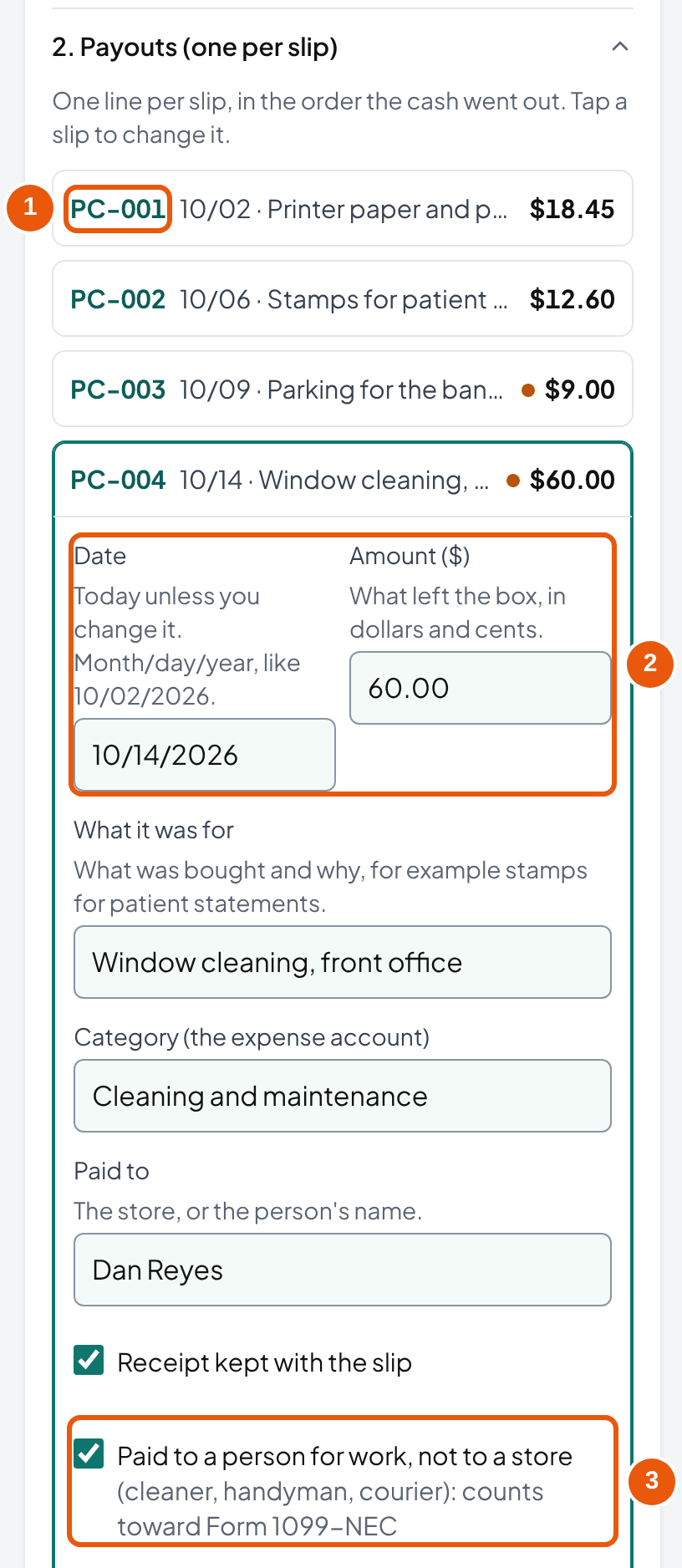
| PC-004 | Oct 14 | Window cleaning · Dan Reyes | Cleaning | Yes | $60.00 | $99.95 |
| PC-005 | Oct 21 | Toner cartridge · Office Depot | Office supplies | Yes | $23.17 | $76.78 |
Three of those lines need more than a receipt. The parking meter gave no receipt, so the slip has to carry the explanation (below). Dan Reyes is a person paid for work, not a store, so his $60.00 counts toward a possible Form 1099-NEC (below). And the toner and the paper go to the same category, which is why the top-up entry has one line for Office supplies, $41.62.
Rules that keep the log honest
- Write the slip when the cash leaves the box, not at month end from memory. A record made at the time is worth more than one rebuilt later, and for a missing receipt the IRS asks for the explanation "at the time of payment".
- Never change an old line. If a slip was wrong, fix it with a new line or at the count, so the log still matches the paper in the box.
- One box, one purpose. Customer cash belongs in the register, not in petty cash. If one box holds both, count and record them separately: the customer cash is sales.
- Change comes back with the receipt. If Ana takes $20 for stamps that cost $12.60, the slip says $12.60 and the $7.40 goes back in the box the same day.
How do you reconcile and replenish petty cash?
In short: Count the cash first, compare it with what the slips say should be there, and top up by the fund minus the cash you counted. Any difference goes to Cash Over and Short. Once the box is topped up (replenished, in the textbooks), it holds the full fund again and the next month starts from there.
- Start$200.00The fund, in the box on October 1
- Slips$123.225 payouts leave $76.78 in the box
- Count$76.28Counted October 31: $0.50 short
- Check$123.72$200.00 − $76.28, written to “Petty Cash”
Back to $200.00: the next period starts from a full box.
- Count before you look at the log, with a second person watching. Write the total on the count sheet and both sign it. Counting first keeps the count honest: you write what's there, not what should be.
- Add up the slips. Every slip in the box should be in the log, and every line in the log should have a slip.
- Work out what should be in the box: the fund minus the slips.
- Compare. The cash counted minus what should be there is the difference: below zero the box is short, above zero it's over.
- Top up by the fund minus the cash counted. That brings the box back to exactly the fund, whatever the difference was.
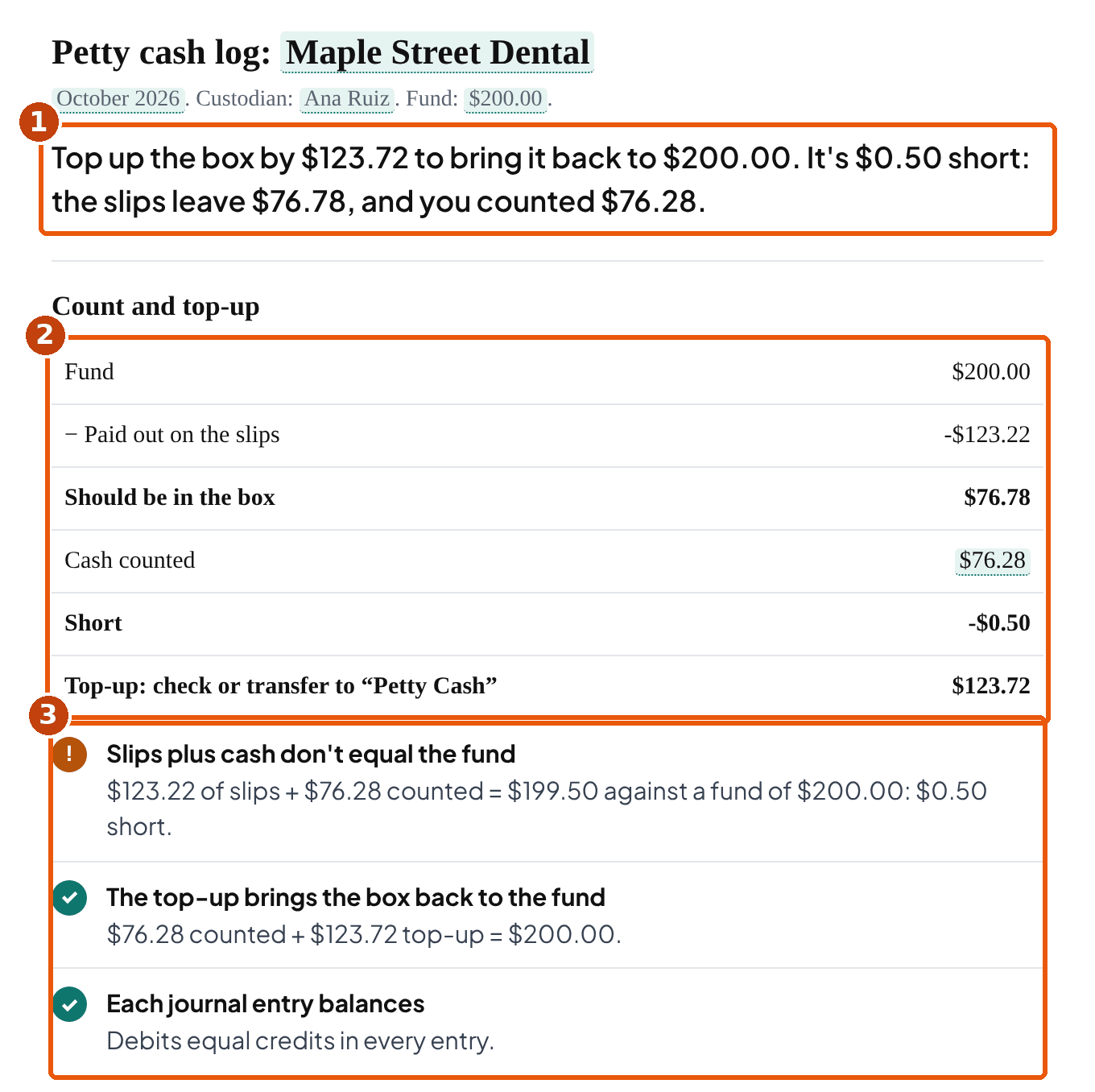
| Fund | $200.00 |
| Slips: $18.45 + $12.60 + $9.00 + $60.00 + $23.17 | − $123.22 |
| Should be in the box | $76.78 |
| Cash counted by Ana and the dentist | $76.28 |
| Short: $76.78 − $76.28 | $0.50 |
| Top-up: $200.00 − $76.28 | $123.72 |
The top-up is $123.72: the $123.22 of slips plus the $0.50 shortage. Write the check for $123.72, not $123.22, or the box starts November $0.50 light.
A top-up equal to the slips is right only when the box is neither over nor short, and that is the case the IRS's example in Publication 583 describes: Henry refills his $50 fund with a check "for the total of the outstanding slips". Some widely read guides say the same, to write the check for the total of the slips. OpenStax's textbook example handles the other case: its $75 fund holds $45 of receipts and $25 of cash, and the top-up covers the receipts plus the $5 shortage. A top-up worked out as the fund minus the cash counted can't drift from one month to the next, because it is defined by where the box has to end up.
Over or short: Cash Over and Short
A small difference is normal: change given wrong at a store, a coin dropped, a slip rounded. Book it to an account called Cash Over and Short (some charts call it Cash Short and Over). A shortage is a debit, like an expense; an overage is a credit, like income. OpenStax's accounting textbook uses the same account in its petty cash example, a $75 fund that comes up $5 short.
Two things are worth doing before you book it. Count again, and look for a slip that never made it into the log, because a slip that was paid but never logged explains a shortage to the cent and belongs to its real expense account. And don't book an unexplained shortage to owner's draws because the business is small: that's right only when the owner took the cash, which is a question to ask, not a default.
Bookkeeper tip: Watch the pattern, not the size. A $0.50 shortage once a year means nothing; the same few dollars missing every month, always under the same custodian, is a reason to count with a second person and change who has the key.
What are the journal entries for petty cash?
In short: Under the usual fixed-fund method, one entry when you top up: debit each expense category and any shortage, credit checking. QuickBooks Online's method books each slip as it happens and makes the top-up a transfer.
The textbook method (fixed or imprest fund)
The payouts get no entry when they happen. At the top-up, the slips are added up by category and recorded in one entry, and the check refills the box. The Petty Cash account itself doesn't move: OpenStax puts it this way, the balance "will never change and will remain on the balance sheet at $75, unless management elects to change the petty cash balance." AccountingCoach says the same: "There is no entry to the Petty Cash account when merely replenishing the petty cash."
| Account | Debit | Credit |
|---|---|---|
| Office supplies ($18.45 + $23.17) | $41.62 | |
| Postage and shipping | $12.60 | |
| Parking and tolls | $9.00 | |
| Cleaning and maintenance | $60.00 | |
| Cash Over and Short | $0.50 | |
| Checking | $123.72 |
Debits $123.72, credit $123.72. This is the entry the IRS example describes: when the fund is restored, the slips are summarized and entered "in the proper columns" of the disbursements journal.
Petty Cash stays at $200.00: prove it on the balance sheet reconciliation, where the account's balance is matched to the cash counted plus the slips not yet booked.
Changing the size of the fund is the only time Petty Cash moves. If Maple Street Dental raises its fund from $200 to $250 at this top-up, the check is $250.00 − $76.28 = $173.72, and the extra $50.00 goes to Petty Cash:
| Account | Debit | Credit |
|---|---|---|
| Office supplies | $41.62 | |
| Postage and shipping | $12.60 | |
| Parking and tolls | $9.00 | |
| Cleaning and maintenance | $60.00 | |
| Cash Over and Short | $0.50 | |
| Petty Cash | $50.00 | |
| Checking | $173.72 |
The QuickBooks Online method
Intuit's help article for QuickBooks Online sets up Petty Cash as its own cash account and says to "record taking cash from petty cash as an expense with petty cash as the payment account." Each slip becomes its own expense the day it's paid, so the Petty Cash balance falls through the month and the top-up is a transfer from checking that brings it back up. It also says the slips and the cash left "should add up to the amount you deposited in the box", the same check as the IRS's. Petty Cash reads $200.00 after the transfer: $200.00 − $123.22 of slips − $0.50 short + $123.72 = $200.00, the figure the balance sheet reconciliation proves.
| Textbook method | QuickBooks Online method | |
|---|---|---|
| When a slip is paid | No entry | An expense, paid from Petty Cash |
| Petty Cash during the month | Stays at $200.00 | Falls to $76.78 |
| Shortage at the count | A line in the top-up entry | An expense paid from Petty Cash, $0.50 |
| The top-up | Expenses by category, credit Checking $123.72 | Transfer, Checking to Petty Cash, $123.72 |
| Good for | Few slips, books kept monthly | Books kept in QuickBooks during the month |
Pick one method and stay with it. The mistake that matters here is mixing them: recording each slip as an expense during the month and then also booking the top-up check to expenses. The same $123.22 of spending is then in the books twice. In the tool, choose the method your books already use and the entries follow it. For the entries around this one (the deposit, the expenses paid by check, the month-end accruals), see more entries in the journal entry builder.
What if there's no receipt?
In short: Write the explanation on the slip when you pay: what was bought, from whom, and why. There's no general rule that payments under $75 need no receipt.
IRS Publication 583 covers the case in one line: "If you cannot get a receipt for a cash payment, you should make an adequate explanation in your records at the time of payment." A parking meter, a tip to a delivery driver, a bus fare: each still gets a slip, signed by whoever took the cash.
A slip with no receipt
Oct 9, 2026. $9.00, city parking meter on Main St., 1 hour, while Luis Ortega took the day's deposit to First Community Bank. No receipt from the meter. Signed: Luis Ortega. Approved: Ana Ruiz.
In the tool: untick "Receipt kept" on the slip; the log flags it and the Excel file counts slips without receipts on the Month end tab. Open the tool ↑
The "under $75" idea people repeat comes from the IRS rules for travel, gift and car expenses. Publication 463 says documentary evidence isn't needed if "Your expense, other than lodging, is less than $75", and the regulation behind it, 26 CFR 1.274-5, applies only to those expenses. It isn't a rule for stamps or toner. Even where it applies, the record of what, when, where and why is still needed.
Bookkeeper tip: Publication 583 also notes that "Proof of payment of an amount, by itself, does not establish you are entitled to a tax deduction." The slip shows the cash left; the description shows it was for the business. Keep both, and keep them as long as the return they support can be examined.
Can you pay a person from petty cash?
In short: You can pay a contractor in cash, but it counts toward Form 1099-NEC: $2,000 or more in a year for 2026 payments. Get a Form W-9 first. Wages never come out of petty cash.
Dan Reyes cleans Maple Street Dental's windows and gets $60.00 from the box each month. He isn't an employee or a corporation, so his cash payments add up toward Form 1099-NEC. The IRS instructions list four conditions: the payee isn't your employee, the payment is for services in the course of your business, it's made to an individual, partnership or estate (or in some cases a corporation), and the total is "at least $2,000 during the year." Nothing in them excludes cash; that's our reading. Payments by card are reported by the card processor on Form 1099-K instead.
- The threshold changed. For tax years beginning after 2025 it's $2,000, up from $600, and it may be adjusted for inflation from 2027. Publication 583 still says $600; the 1099 instructions are newer.
- Ask for a Form W-9 before you pay. The IRS form exists so the payer can get the payee's taxpayer identification number. Getting it while the person is standing there takes a minute; getting it in January can take weeks. A payee who never gives a taxpayer identification number can also put the business under the backup withholding rules, which means holding back 24% of the payment, something that's hard to do with cash from a box.
- Form 1099-NEC goes to the payee and the IRS early in the new year. The IRS's General Instructions for Certain Information Returns give the exact day each year, and a due date that lands on a weekend or holiday moves to the next business day.
- Add petty cash to everything else. $60 a month from the box is $720 a year; if the same person is also paid by check, the two add up. The accounts payable template tracks 1099 payees the same way for the bills paid by check, so the two totals can be added at year end.
Tick "Paid to a person for work" on the slip in the tool and it totals each person's payments for the period and flags them. Some organizations avoid the question entirely: the University of Houston System's petty cash policy, for example, rules out payments to individuals for personal services.
Cash advances to employees
Cash handed out before a purchase, for example $100 for supplies on a trip, isn't an expense yet. Keep a signed IOU slip in the box until the receipts and change come back. For it to stay out of the employee's wages, the federal rules for accountable plans set a reasonable-time safe harbor in 26 CFR 1.62-2: the advance within 30 days of the expense, the receipts within 60 days after it, and any unspent cash back within 120 days.
Which petty cash controls matter in a small office?
In short: Three: one person holds the cash, someone else records and approves, and someone counts without warning now and then. A per-purchase limit helps; a big fund doesn't.
Small organizations stand out in the fraud cases examiners report. In the ACFE's 2026 Report to the Nations, a study of 2,402 occupational fraud cases investigated by its members, organizations with fewer than 100 employees had the highest median loss of any size group, $126,000. Theft of cash on hand appeared in 13% of their cases against 8% for larger organizations, and expense reimbursement schemes in 19% against 10%. Cash on hand schemes ran a median of 9 months before they were caught.
| Control | What it looks like in a small office | Where it comes from |
|---|---|---|
| Separate custody, recording and approval | Ana holds the box; the bookkeeper records the top-up; the dentist signs the check | GAO Green Book, segregation of duties: separate "authorizing transactions, processing and recording them, reviewing the transactions, and handling any related assets" |
| Physical control | A locked box, one key, kept out of sight | GAO Green Book: limited access to "assets such as cash" and periodic counts compared with the records |
| Surprise counts | The owner counts the box on a random day against the log's balance | University of Houston System policy: funds "are subject to surprise cash counts"; ACFE 2026: median loss $74,000 where surprise audits were in place, $149,000 where they weren't (an association, not proof) |
| Per-purchase limit | Anything over $100 goes on the business card | University of Houston System and UNC Charlotte policies: $100 per transaction |
| Monthly top-up | Top up at month end even if the box isn't empty | OpenStax: monthly reimbursement "ensures that the expenses are recognized within the proper accounting period" |
The university policies are one institution's rules, not law, but they show what a written policy covers: the limit, who the custodian is, surprise counts, receipts, and what petty cash can't pay for. UNC Charlotte's, for example, rules out using it to pay wages for students or temporary employees.
What if a client's petty cash has no log?
In short: Count the box today, collect whatever receipts are in it, and start the log from today's count. Don't try to rebuild months nobody recorded.
- Count the cash with the client present and write the date and total down. That is the only number you know for sure.
- Match the receipts in the box to categories and record them as expenses of the months they belong to, if they're business purchases, or in the current month if those months are closed or the return is filed.
- Compare with the books. Petty Cash in the ledger should equal the cash counted plus the receipts not yet booked. What's left is unexplained: ask the client whether they took cash for themselves (owner's draws). A small remainder can go to Cash Over and Short; a large one, or one that spans years, is a question for the client and their tax preparer, not an expense to book quietly.
- Reset the fund. Pick the fixed amount going forward, top the box up to it, and start the log with today's date and that amount. From here the equation holds again.
Bookkeeper tip: Put the starting count and the agreed fund amount in writing, signed by the client. When the first month-end comes, the difference you find is the client's first month, not the last three years.
How do you make a petty cash log in Excel?
In short: One input cell for the fund, a row per slip, and three formulas: the running balance, the total, and the top-up. Or download ours, which has them already (cell addresses from the file as downloaded with up to 25 slips; the total row moves down with more).
| Cell | Formula | What it does |
|---|---|---|
| C7 | 200 | The fund (an input, in yellow) |
| H10, copied down | =IF(G10="","",$C$7-SUM($G$10:G10)) | Balance after each slip: the fund minus everything paid out so far, blank until there's an amount |
| G51 | =SUM(G10:G49) | Total paid out |
| Month end B7 | =B5-B6 | Should be in the box: fund minus total paid out |
| Month end B9 | =B8-B7 | Over (+) or short (−): counted minus should be |
| Month end B11 | =B10-B8 | Top-up: fund after the top-up minus cash counted |
| By category B5 | =SUMIF(Log!$D$10:$D$49,A5,Log!$G$10:$G$49) | Total for one category, the line for the top-up entry |
Working the balance out from the fund each time, rather than from the row above, means a blank row or a deleted line can't break every balance below it. The download also rounds each total to the cent, has drop-down lists for the category and the yes-or-no columns, a bill-and-coin count, and the journal entry built from the totals, so the file works as next month's log too. It's a standard .xlsx file, so Google Sheets and LibreOffice open it as well. If you'd rather keep the log on paper, the tool prints a blank log with 25 lines and the month-end count.
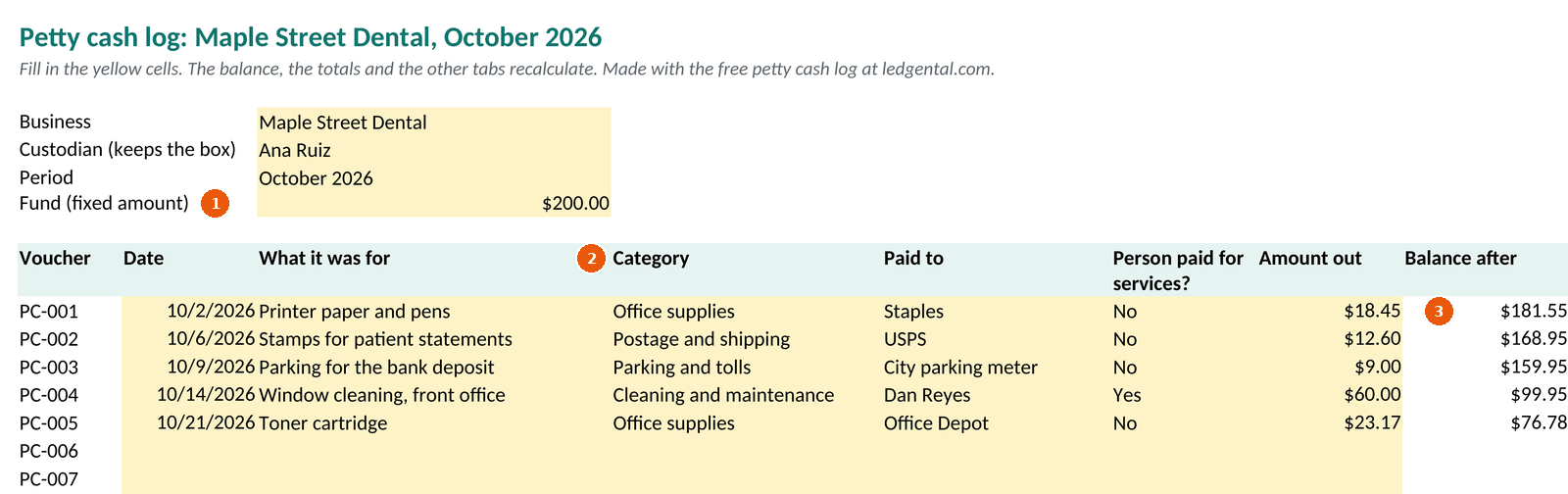
A "petty cash book" is the same record with one column per category, often called an analytical petty cash book. Totaling each column gives the debits for the top-up entry. The By category tab does the same job without making the log wide.
Common petty cash mistakes
In short: Most of them come from losing sight of the one equation: slips plus cash equal the fund.
| Risky | Safer |
|---|---|
| Topping up by the total of the slips | Topping up by the fund minus the cash counted, so a shortage doesn't carry into next month |
| Booking each slip as an expense and then the top-up check to expenses too | One method: the top-up entry by category, or each slip as an expense with the top-up as a transfer |
| Counting the box after reading the log's balance | Counting first, with a second person, and comparing after |
| Booking an unexplained shortage to owner's draws by default | Cash Over and Short, unless the owner says they took it |
| Paying a cleaner in cash all year with no W-9 | A W-9 before the first payment, and the cash added to the year's Form 1099-NEC total |
| A box that also holds customer payments, counted as one | Customer cash in the register, or counted and recorded separately as sales |
| Topping up only when the box is empty | Topping up at month end too, so the expenses are in the right month |
| Editing last week's line to make the balance work | A new line or an over or short at the count, with a note |
If more than one of these sounds familiar, start at the count: count the box today, enter the slips you have in the tool, and let the difference tell you how far off the records are.
Frequently asked questions
What is a petty cash log?
A petty cash log is the running record of a small cash fund: one line for each payout with the date, what it was for, who was paid, the amount and the cash left, plus the month-end count and the top-up. With a $200 fund and $123.22 of slips, the log says $76.78 should be in the box, which is what the count is checked against.
How do I create a petty cash log in Excel?
Put the fund amount in one cell and give the log these columns: slip number, date, what it was for, category, paid to, amount out, balance after, receipt yes or no, and taken by. The balance formula is the fund minus the sum of the amounts so far, for example =$C$7-SUM($G$10:G10), copied down. Add a total, a cell for the cash counted, and a top-up cell that is the fund minus the cash counted. The free download on this page has those formulas, plus a category summary, a bill-and-coin count and the journal entry.
How do you keep track of petty cash?
Give one person the box, write a slip for every payout with the receipt stapled to it, and record each slip in the log the same day. At the end of each month, or whenever the box runs low, count the cash, check that the slips plus the cash equal the fund, and write a check or transfer for the fund minus the cash counted. IRS Publication 583 describes the same routine: the unspent cash plus the slips should equal the fixed amount of the fund.
How can I create a petty cash book in Excel?
A petty cash book is the same log with one column per expense category (an analytical petty cash book), so each payout's amount goes in its category's column as well as the total column. Totaling each column at month end gives the debits for the top-up entry. The download on this page does the same with a By category tab that adds up the log with SUMIF, so you keep one amount column and still get the totals by account.
How much money should be in a petty cash fund?
No rule sets it. A workable size covers about a month of the small cash payments the business actually makes, so the box is topped up once a month and the books get the expenses in the right month. IRS Publication 583 uses a $50 fund in its example; two university policies we read cap each purchase at $100. If the box runs dry before month end, raise the fund; if cash sits unused, lower it.
How often should petty cash be replenished?
At least once a month, at month end, and also whenever the cash runs low. Topping up at month end puts the month's petty cash expenses into the right period; OpenStax's accounting textbook notes that many small businesses reimburse the fund monthly for that reason.
What do you do when petty cash is short?
Count again with a second person, look for a slip that wasn't logged, and then record what's left in Cash Over and Short, an account that works as an expense when the box is short and as income when it's over. The top-up is the fund minus the cash counted, so it covers the shortage too: with $76.78 expected and $76.28 counted, the top-up is $123.72, not the $123.22 of slips. Book it to owner's draws only if the owner actually took the cash.
Is petty cash an asset?
Yes. Petty Cash is a current asset in the cash group on the balance sheet. Under the usual fixed-fund method it stays at the fund amount, such as $200, because the payouts are recorded as expenses when the fund is topped up, and the account changes only when the fund itself is made bigger or smaller.
Do you need a receipt for petty cash under $75?
There's no general under-$75 exception. The $75 rule is in the IRS rules for travel, gift and car expenses (Publication 463 and the regulation behind it). For other cash payments, IRS Publication 583 says that if you can't get a receipt, make an adequate explanation in your records at the time of payment. Write on the slip what was bought, from whom, and why.
Can you pay a contractor from petty cash?
You can, but it counts toward Form 1099-NEC like any other payment for services. For payments in 2026 a business files Form 1099-NEC for a non-employee it paid at least $2,000 for services during the year, early in the following year. Ask for a Form W-9 before you pay. Many businesses keep services out of petty cash entirely, and wages always go through payroll.
What's the difference between petty cash and a cash drawer?
Petty cash is for paying small business expenses; a cash drawer or change fund holds the cash customers pay in. If a business keeps them in one box, count and record them separately: the customer cash is sales, and only the payouts belong in the petty cash log.
How we built this page
Ledgental Team wrote this guide and built the log. Ledgental also makes a bookkeeping app that's free during its beta; this tool doesn't connect to it. Everything you type stays in your browser.
What the numbers rest on
- The arithmetic starts from the IRS's fixed-fund equation: the slips plus the cash equal the fund, so what should be in the box is the fund minus the slips. The top-up is the fund minus the cash counted, which is the slip total adjusted for any over or short, as in OpenStax's example. Amounts are added in cents and rounded half away from zero, the way Excel's ROUND does. The engine is checked by 23 known-answer tests worked out by hand, including the running example, an overage, a fund made bigger and smaller, a bill-and-coin count, a slip with no account chosen, and a payout over the fund; 3 more tests hold the Excel file's cell addresses and formulas to what this guide says.
- The journal entries follow OpenStax's petty cash chapter and AccountingCoach for the textbook method, and Intuit's QuickBooks Online help for the register method. The tool checks that every entry balances.
- The tax points (no receipt, the $75 rule, Form 1099-NEC at $2,000, Form W-9, accountable-plan time limits) come from IRS publications, the 1099 instructions and the regulations, quoted in the text and read on October 4, 2026.
- Not covered: splitting sales tax out of purchases (enter what was paid), several funds in one log, foreign currency, cash registers and change funds, and payroll. Maple Street Dental and everyone in it are fictional.
What changed
- October 4, 2026: first published: the log with running balance, bill-and-coin count, over or short, top-up, both journal entry methods, flags for missing receipts, people paid for work and payouts over a limit; an Excel file with formulas, drop-downs and the entry; CSV; printable blank slips; and the guide.
Cite this page
Writing about this? Use one of these lines. To point at one section, use the link icon beside its heading.
- Plain line
- Ledgental, Petty Cash Log Template, updated October 2026, https://ledgental.com/tools/petty-cash-log-template
- APA
- Ledgental. (2026, October). Petty Cash Log Template. https://ledgental.com/tools/petty-cash-log-template
- Chicago
- Ledgental. “Petty Cash Log Template.” Last modified October 2026. https://ledgental.com/tools/petty-cash-log-template.
Reusing this page: the guide's text, tables, and screenshots are licensed under CC BY 4.0. Credit "Ledgental" with a link to this page. Quotations from the IRS and GAO are public domain, and quotations from other sources stay under their owners' terms.
Sources
- Publication 583, Starting a Business and Keeping Records (petty cash fund, Henry's $50 example, records without receipts), Internal Revenue Service
- Publication 463 (2025), Travel, Gift, and Car Expenses (the $75 documentary evidence exception), Internal Revenue Service
- Instructions for Forms 1099-MISC and 1099-NEC ($2,000 threshold), Internal Revenue Service
- About Form W-9, Request for Taxpayer Identification Number and Certification, Internal Revenue Service
- 26 CFR 1.274-5, Substantiation requirements, Cornell LII copy
- 26 CFR 1.62-2, Reimbursements and other expense allowance arrangements, Cornell LII copy
- Standards for Internal Control in the Federal Government (Green Book), GAO-14-704G, U.S. Government Accountability Office
- Principles of Accounting, Volume 1, 8.4: Petty Cash Fund and Petty Cash Journal Entries, OpenStax, Rice University (CC BY-NC-SA 4.0)
- What does it mean to replenish the petty cash fund?, AccountingCoach
- How is the account Cash Short and Over used?, AccountingCoach
- Set up and use petty cash in QuickBooks Online, Intuit
- Occupational Fraud 2026: A Report to the Nations, Association of Certified Fraud Examiners
- SAM 03.A.07, Petty Cash Funds (revised September 17, 2025), University of Houston System
- University Policy 602.3, Petty Cash Fund and Change Fund Policy, UNC Charlotte
General information, not tax or accounting advice. IRS rules and the other sources were read on October 4, 2026, and they change; check the current publication before relying on a figure. Maple Street Dental and the people in its example are fictional. This page isn't affiliated with the IRS, Intuit or any university.