Key takeaways
- Roll Sales Tax Payable forward from the reports and the bank, not the ledger: opening balance + tax charged − tax refunded − tax paid − discount kept. Then compare the result with the books, and check that it equals the tax on returns not yet paid.
- A difference usually equals one amount you already have. In our example the books are $165.00 high, which is exactly the tax Amazon collected on $2,000 of sales, so match the size first and then look for the entry.
- The timely-filing discount is income, not a smaller liability: the IRS says to include any sales tax the state lets you keep as income on Schedule C line 6. Several states changed their discount in 2025 and 2026.
- States disagree on marketplace sales (Texas: in total sales, not taxable sales; Florida and Illinois: leave them off) and on cash or accrual (California requires accrual; Texas allows cash basis by election).
- Of the states we checked, only Hawaii (G-49) and Michigan (5081) add an annual return on top of the periodic ones, and Rhode Island dropped its annual reconciliation from tax year 2023.
What is sales tax reconciliation?
In short: It's the check that the tax charged to customers, the Sales Tax Payable balance, the tax on the return, and the payment to the state agree, so that what's left in the account is exactly the tax on returns not yet paid.
Each of the four numbers comes from a different place, and each can go wrong on its own. The sales system can charge the wrong rate, an integration can post tax that isn't the client's, a payment can be coded to an expense, and a return can be prepared from the wrong report. A reconciliation catches these while they're still small, and it leaves a workpaper that shows how the return was prepared.
- Charged to customers$4,042.50Sales tax report: $4,125.00 charged − $82.50 refunded
- In the books$4,207.50Sales Tax Payable at March 31
- On the return$4,042.50March return, due April 20
- Paid to the state$4,022.29April 20: the return less the 0.5% discount ($20.21)
Two different things share the name. Most of the time it means the check above, done each time the client files. A few states also require an annual reconciliation return, a separate form for the whole year, which is covered below. The next section walks through one month with real numbers.
How do you reconcile sales tax payable?
In short: Start from last period's balance, add the tax charged, subtract the tax refunded, paid, and kept as a discount, and compare the result with the books. Then check that the result equals the returns not yet paid.
Take Maple & Pine Home Goods, a home goods store in Texas that files monthly. The business is fictional, and 8.25% is an example rate: Texas has a 6.25% state rate and up to 2% in local tax. Its bookkeeper reconciles March 2026 before preparing the March return, using three documents: the store's sales tax report, the bank statement, and the February return.
- Take the opening balance from the books: Sales Tax Payable on the last day of the previous period. It's the only number that comes from the ledger, so it should be the balance you reconciled last time.
- Add the tax charged to customers, from the sales system's tax report. Leave out sales where a marketplace collected the tax.
- Subtract the tax refunded on returns and credit memos.
- Subtract what the client paid the state during the period, from the bank statement, leaving out any penalty or interest.
- Subtract any timely-filing discount kept on that payment.
- Compare the result with Sales Tax Payable in the books on the last day of the period.
- Check that the result equals the tax on returns not yet paid at the end of the period.
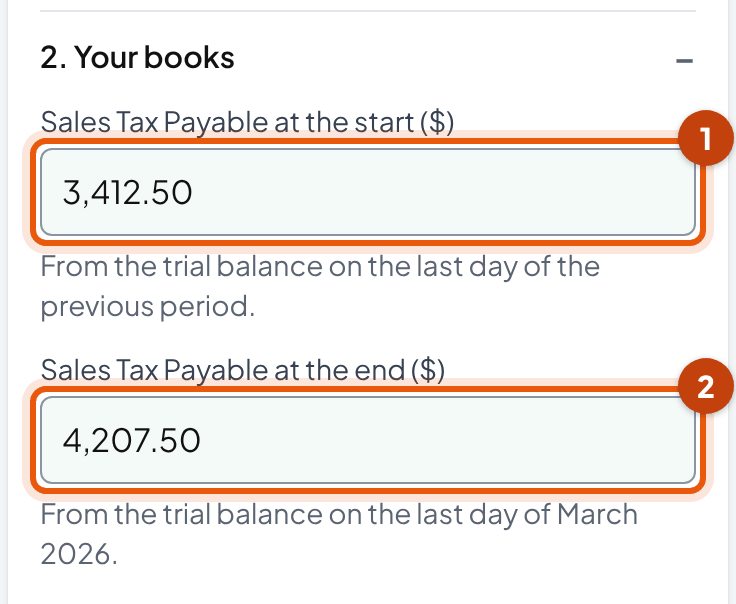
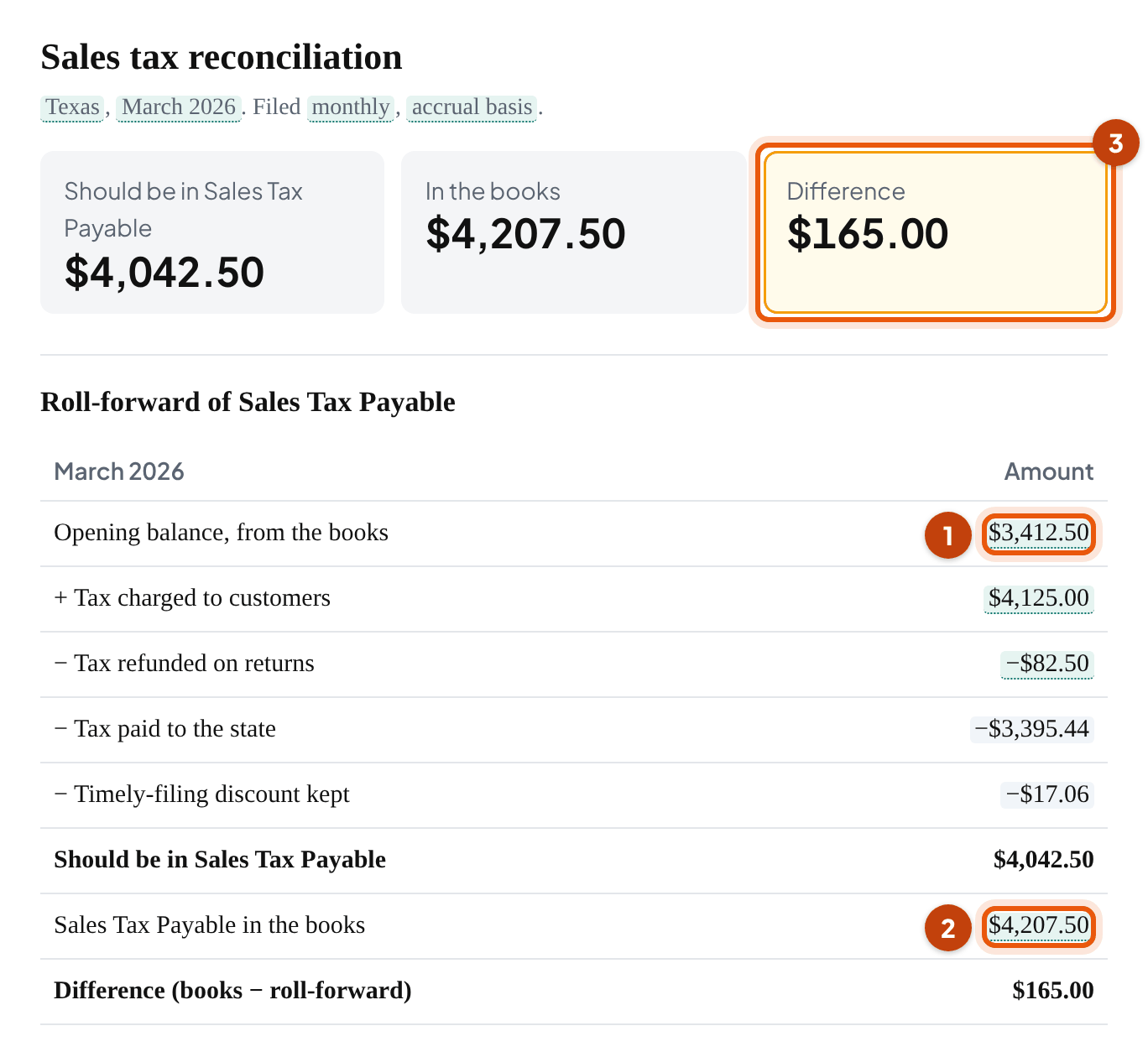
| Opening balance, February 28 (the February return, not yet paid) | $3,412.50 |
| Tax charged: $50,000 of taxable sales × 8.25% | + $4,125.00 |
| Tax refunded: $1,000 of returns × 8.25% | − $82.50 |
| February return paid March 20: $3,412.50 − $17.06 | − $3,395.44 |
| 0.5% timely-filing discount: $3,412.50 × 0.5% | − $17.06 |
| Should be in Sales Tax Payable on March 31 | $4,042.50 |
| Sales Tax Payable in the books | $4,207.50 |
| Difference | $165.00 |
The roll-forward says $4,042.50 and the books say $4,207.50, so $165.00 needs explaining before the March return goes in.
The proof: what should be left
The roll-forward tells you what the account should hold, but not whether that amount is right. The proof does: at the end of a period, Sales Tax Payable should equal the tax on returns that haven't been paid yet, and for a monthly filer that's usually just the return for the month you closed. Maple & Pine's March return shows $49,000 of taxable sales and $4,042.50 of tax, due April 20, 2026. That matches the roll-forward, so once the $165.00 is explained, nothing else is left in the account.
Why build the roll-forward from the reports and the bank instead of the ledger? Because the ledger is what you're testing. If an integration posted the wrong amount, adding up the ledger repeats the mistake, while adding up the reports doesn't.
Bookkeeper tip: Reconcile before you prepare the return, not after. The difference then gets fixed on the return it belongs to, and the return comes from numbers you've already tied out. Enter the period in the tool above and it does the arithmetic as you type.
Why doesn't Sales Tax Payable match the return?
In short: Because an entry put something in Sales Tax Payable that isn't tax the client owes, or left out tax that is. The size of the difference usually points to the cause.
Before you go through the ledger line by line, compare the difference with amounts you already have. The difference is the books minus the roll-forward, so it's negative when the books are lower. Each common cause leaves a difference of a known size:
| The difference equals | Likely cause | Fix |
|---|---|---|
| Tax the marketplace collected | A sales or payout integration recorded the marketplace's tax in Sales Tax Payable | Move it out of the liability (entry below) |
| The payment to the state | The payment was coded to an expense such as "Taxes and licenses" | Reclassify the payment to Sales Tax Payable; profit was understated by the same amount |
| The discount | The payment cleared only the cash paid, and the discount stayed in the account | Move the discount to other income |
| Minus the penalty | Penalty or interest was posted against the liability | Move it to an expense account |
| Tax refunded | Refunds reversed the sale but not its tax | Record the tax on the refunds |
| Minus the payment | The payment was recorded twice, from the bank feed and by hand | Delete the duplicate |
| None of these | Several smaller causes, or a timing difference | Go through the period's entries to the account one by one |
Maple & Pine's $165.00 is 8.25% of the $2,000 the store sold on Amazon in March. Amazon's tax report shows that Amazon collected that tax, but the store's Amazon integration had also recorded it in Sales Tax Payable along with the sales. Texas puts the collection on the marketplace once the marketplace certifies that it collects, so the $165.00 isn't the store's to pay. Left there, it overstates the liability, and a return prepared from the ledger would include tax Amazon has already paid.
| Account | Debit | Credit |
|---|---|---|
| Sales Tax Payable | $165.00 | |
| Amazon clearing account | $165.00 |
The credit side depends on how the integration recorded the sale. Open the original entry before you post this; ours assumes the payouts run through a clearing account.
When the difference equals the marketplace's tax, the discount, the penalty, the payment, or the refunded tax, the tool's journal entries include the correcting entry. A duplicate payment or a mix of causes you'll need to trace yourself.
When it's a timing difference
Some differences aren't errors. A sale invoiced on March 31 and recorded in April, a refund issued in one month for a sale in another, or a payment that clears the bank a day after month end all move tax between periods. Write the timing difference into the workpaper with the date it reverses, and check next month that it did. On a cash basis, tax on unpaid invoices is a timing difference too, covered below.
| Risky | Safer |
|---|---|
| Plugging the difference to sales or an expense so the account ties | Leaving it open in the workpaper until the cause is found |
| Booking the payment as "sales tax expense" | Debiting Sales Tax Payable with the payment |
| Letting the marketplace integration post tax to the liability | Mapping marketplace tax to the clearing account, not Sales Tax Payable |
| Preparing the return from the ledger balance | Preparing it from the sales reports you've tied to the ledger |
How do you record the timely-filing discount?
In short: As income. The payment clears the full tax on the return, and the part the state lets the client keep goes to other income.
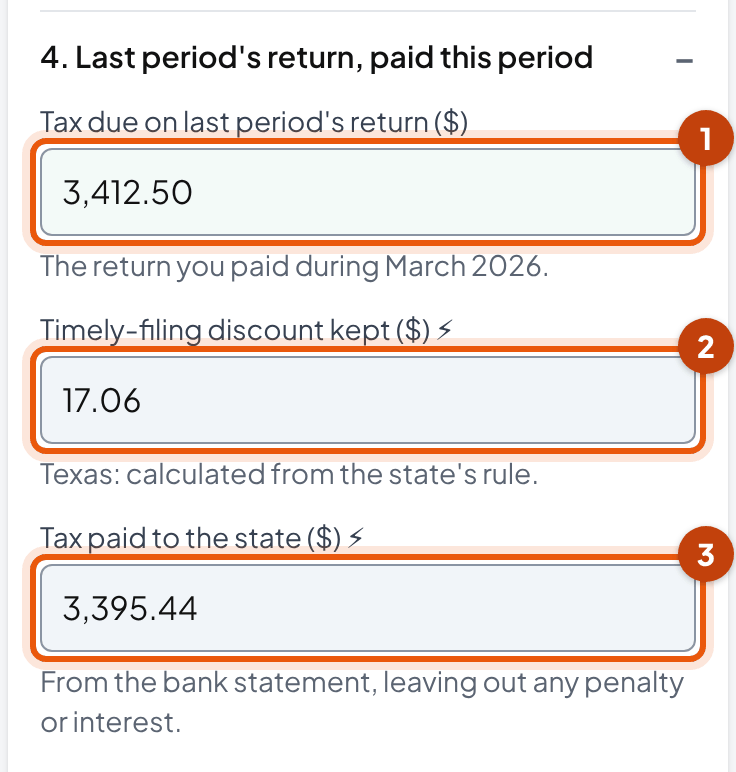
Texas allows a 0.5% discount for filing and paying on time. On Maple & Pine's February return of $3,412.50 that's $17.06, so the store paid $3,395.44. The full $3,412.50 comes off Sales Tax Payable, because that's what was owed. The IRS Schedule C instructions are direct about the rest: "if the state or local government allowed you to retain any part of the sales tax you collected, you must include that amount as income on line 6."
| Account | Debit | Credit |
|---|---|---|
| Sales Tax Payable | $3,412.50 | |
| Checking | $3,395.44 | |
| Other income: sales tax timely-filing discount | $17.06 |
We apply the Texas 0.5% to the tax due on the return. The Comptroller's page confirms the rate but doesn't show the computation, so check it against the line on the return. Texas also has a separate 1.25% discount for prepaying, which the tool doesn't calculate.
What changed in 2025 and 2026
If you reuse last year's workpaper, check these first. Each comes from the state's bulletin, form, or law:
| State | Change | From |
|---|---|---|
| Illinois | 1.75% now capped at $1,000 for each month a return covers | Returns due January 1, 2025 |
| Louisiana | 1.05% applies to part of the state tax only (about 0.84%), capped at $750 a month per dealer (was $1,500) | Periods from January 1, 2025 |
| Ohio | 0.75% now capped at $750 per vendor's license for each month covered | Returns due January 1, 2026 |
| Colorado | No state service fee (was 4%, up to $1,000 a period); local fees may still apply | January 1, 2026 |
| South Dakota | Collection allowance suspended (from the enrolled 2025 bill; we didn't see the signed copy) | July 1, 2025 to June 30, 2028 |
The tool has a rule for each of the 45 states with a statewide sales tax and DC, with its source and how firmly we could confirm it. For 15 of them, DC included, we found no discount on the current return or instructions, though no state text says "none" outright. For a few others, either we couldn't confirm the rate at the state or the discount depends on figures the tool doesn't ask for (Virginia's depends on monthly taxable sales), so the tool asks you to enter it from the return.
How do marketplace sales affect the reconciliation?
In short: The marketplace collects and pays the tax, so that tax stays out of the client's Sales Tax Payable. The sales still count, but each state wants them shown differently on the seller's own return.
A 2022 GAO report found that, as of June 2021, every state with a sales tax except Oklahoma required marketplaces to collect; Oklahoma let them choose to report the sales instead. The Streamlined Sales Tax Governing Board's page now lists Oklahoma as requiring collection, so check the current rule there. What varies is the seller's return:
| State | Marketplace sales on the seller's return |
|---|---|
| Texas | Include them in Item 1, Total Texas Sales; leave them out of Item 2, Taxable Sales |
| California | Include them in total sales, then deduct them as "other" |
| Washington | Report them in gross sales under Retailing B&O, then take the "Gross Sales Collected by Facilitator" deduction |
| New York | Include them in gross sales and services, and in nontaxable sales |
| Florida | Leave them off the return, when the marketplace has certified that it collects |
| Illinois | Leave them off Form ST-1; don't include them and then deduct them |
| Michigan | Don't report them on Line 1A of the annual Form 5081 |
For Maple & Pine that means a March return with $51,000 of total sales ($49,000 from the store after returns, plus $2,000 on Amazon) and $49,000 of taxable sales. In Florida, the same store would report $49,000 in both.
Reading Amazon's tax report
Amazon's US Sales Tax Report is a tab-separated file you generate from the Tax Document Library in Seller Central. Its columns include Tax_Collection_Responsible_Party, Taxable_Amount, Tax_Amount, Jurisdiction_Level, and Total_Tax_Collected_By_Amazon.
Two cautions before you add it up. The Jurisdiction_Level column suggests one row for each level (state, county, city), which is our reading rather than Amazon's wording, so check whether the taxable amount repeats before you total it. And some guides name columns that aren't in Amazon's documentation: there's no "Tax_Rate", and the rate column is Taxed_Jurisdiction_Tax_Rate. In the tool, open Sales reports and use the import: it reads the file in your browser, adds up the column you pick, and can filter by any column, such as Tax_Collection_Responsible_Party.
Form 1099-K: third-party payment platforms (marketplaces and payment apps) report a seller's sales on Form 1099-K when the year has more than $20,000 and more than 200 transactions, the threshold in force again for 2025 and 2026. The IRS defines the amount as the gross total "without regard to any adjustments for credits, cash equivalents, discount amounts, fees, refunded amounts, or any other amounts", and IRS Publication 334 adds that it "may include items that are not included in your receipts (such as sales tax)." So when you compare a 1099-K with the books, check whether tax is in its total before you treat a gap as missing sales.
Is sales tax due when you sell or when the customer pays?
In short: The state decides, not the books. Several states make the tax due when the sale is made, even for a client whose books are on a cash basis.
| State | When tax on a credit sale is reported | Bad debts |
|---|---|---|
| California | Accrual for every retailer (Reg. 1642) | Deduct on the return, under "Bad Debt Losses on Taxable Sales", in the period the account is written off for income tax |
| New York | In the period of the sale, "whether or not any money was collected" | Credit or refund within 3 years of when the tax was payable (Schedule CW with the return) |
| Florida | "At the moment of the transaction" | Credit or refund within 12 months after the month of the federal charge-off |
| Texas | On the basis of the books; an accrual-basis retailer may elect cash basis for sales tax, going forward | Credit on the return or a refund, within 4 years of the federal charge-off |
Say Maple & Pine invoices a business customer for $10,000 of furniture on March 28 and gets paid in May. On an accrual basis, the $825 of tax goes on the March return; if the store had elected cash basis for sales tax, it would go on the May return instead. The same invoice in California would be on the March return either way, so the reconciliation would start from invoices, not deposits. Mark the basis on the workpaper so the next person doesn't "fix" a difference that's only timing.
Which states require an annual sales tax reconciliation?
In short: Of the states we checked, Hawaii and Michigan, each on top of the monthly or quarterly returns. Rhode Island dropped its annual reconciliation from tax year 2023.
| State | Annual return | Due | What we found on penalties |
|---|---|---|---|
| Hawaii | Form G-49, annual return and reconciliation (general excise tax), filed by all filers | 20th day of the 4th month after the tax year (April 20 for a calendar year) | The general late-filing penalty: 5% a month, up to 25% of the tax due |
| Michigan | Form 5081, annual return; "Do not use this form to replace a monthly/quarterly return" | February 28 (for 2025: February 28, 2026) | With no tax due, $10 a day up to $400; with tax due, 5% plus 5% a month after the second month, up to 25%, plus interest |
| Rhode Island | RI-STR-Annual "no longer required for Tax Year 2023 and forward". Liquor stores (T-204A) and writers, composers, and artists (T-204W) still file one | The 2024 forms say January 31, 2025 | None shown on the forms |
Many states let small sellers file once a year, but that annual return replaces the monthly or quarterly ones rather than reconciling them. In the other states we checked we found no extra annual return. Ohio's law lets the state require a reconciliation return, and we couldn't confirm whether it does; we didn't check North Dakota, South Dakota, Pennsylvania, or Vermont. Connecticut's annual disaggregated report for multi-location filers became quarterly on October 1, 2026, and it carries no tax.
If the monthly reconciliations tie, the annual return should equal the sum of the year's returns, so the twelve workpapers are most of the work for it: add up the tool's Excel files for the year and compare the totals with the annual form.
What do auditors compare in a sales tax audit?
In short: The books against the sales tax returns, and the returns against the income tax return. Your reconciliations are the explanation for any gap.
California's audit publication says the auditor tests "Total sales recorded on your books to the total sales reported on your sales tax returns", the same books against the income tax returns, and the "Amount of tax you collected to the tax reported on your returns". The Texas Comptroller's audit manual compares reported gross sales with federal income tax returns, franchise tax gross receipts, and financial statements, and lists cash versus accrual reporting as one of the differences to account for. So keep the year's sales on the returns reconciled to the income tax return, with marketplace sales and timing differences written out.
| State | Keep records | Assessment period | No limit (or longer) when |
|---|---|---|---|
| California | At least 4 years | 3 years | 8 years if no return was filed; the 3-year rule doesn't apply to fraud |
| New York | 3 years from the due date (or filing date, if later) | Generally 3 years | No return filed, or a false or fraudulent return |
| Florida | 3 years | 3 years | Failure to file or pay, or a fraudulent return |
| Texas | At least 4 years | 4 years from the due date | Not confirmed at an official source |
Bookkeeper tip: Keep each period's workpaper with the sales tax report, the marketplace tax report, the bank statement line for the payment, and the return as filed. The tool's Excel download has a sign-off line for the preparer and the reviewer.
How do you fix a mistake on a filed return?
In short: Amend it through the state's system and pay the difference with interest. For periods that were never filed, look at the state's voluntary disclosure program before the state contacts the client.
| State | Amend | Late penalties | Voluntary disclosure |
|---|---|---|---|
| California | Online Services, Amend Return; a refund turns it into a claim for refund | 10% for late filing and 10% for late payment, up to 10% a return in all; interest at the IRS rate + 3% | Out-of-State Voluntary Disclosure Program for remote sellers (the in-state program covers purchasers' use tax); 3-year lookback, penalties can be waived |
| New York | Allowed unless it lowers a past-due amount; a self-reported one can be lowered within 180 days | 10% + 1% a month, up to 30%; at least $50 for late filing; interest 14.5% (Q4 2026) | Voluntary Disclosure and Compliance Program, no penalties |
| Florida | Mark the corrected return "Amended replacement" | 10% or $50, whichever is more, even on a zero return; interest 11% (July–December 2026) | 3-year lookback, penalties waived once tax and interest are paid |
| Texas | Webfile: change only the data that needs amending | $50 a late report; 5% (1–30 days), 10% (over 30 days), 20% after a notice; interest 7.75% for 2026, from day 61 | 4-year lookback; no limit for tax collected and not paid |
Penalties are the practical case for reconciling before filing: Florida's minimum applies even to a zero return, and in Texas and New York the percentage grows the longer the balance runs. If the reconciliation finds tax that was collected and never paid, look at the state's voluntary disclosure program before the state contacts the client. In Texas, for example, the 4-year lookback doesn't apply to that tax, so every period counts.
Penalty and interest are a cost of the business, not tax owed to the state, so book them to an expense account rather than Sales Tax Payable. Whether they're deductible for income tax is a question for the tax preparer.
Frequently asked questions
What is a sales tax reconciliation?
It's a check that the sales tax charged to customers, the Sales Tax Payable balance in the books, the tax on the returns, and the payments to the state agree for a period. The balance left in Sales Tax Payable at the end should equal the tax on returns that haven't been paid yet.
How often should I reconcile sales tax?
Each time the client files, before the return goes in, so a difference is found while it can still be fixed on that return. For a monthly filer that's every month. A year-end pass then ties the year's returns to the sales on the books and the income tax return.
Why doesn't Sales Tax Payable match the sales tax return?
The usual causes are marketplace tax recorded in the liability, a payment coded to an expense, a timely-filing discount left in the account, penalties posted against it, refunds recorded without their tax, and payments in the wrong period. Compare the size of the difference with each of these first. When it equals the marketplace's tax, the discount, the penalty, the payment, or the refunded tax, the tool's journal entries include the correcting entry.
Is the sales tax discount income?
Yes. The IRS Schedule C instructions say that if the state or local government allowed you to retain any part of the sales tax you collected, you must include that amount as income on line 6. Book it to other income, not as a smaller liability.
Should marketplace sales be included on the seller's sales tax return?
It depends on the state. Texas wants them in total sales but not taxable sales, California has sellers include them and deduct them, and Florida and Illinois have sellers leave them off. The tax the marketplace collected isn't the seller's to pay either way, so it shouldn't sit in Sales Tax Payable.
Which states require an annual sales tax reconciliation?
Of the states we checked, Hawaii (Form G-49) and Michigan (Form 5081) require an annual return on top of the monthly or quarterly ones. Rhode Island dropped its annual reconciliation from tax year 2023, except for liquor stores and for writers, composers, and artists. Many other states let small sellers file once a year, but that replaces the periodic returns rather than adding to them.
What does a sales tax auditor compare?
California's audit publication says the auditor compares sales in the books with sales on the sales tax and income tax returns, and tax collected with tax reported. The Texas audit manual also compares reported sales with federal income tax returns, franchise tax gross receipts, and financial statements, and lists cash versus accrual timing as a difference to explain.
Is sales tax due when the sale is made or when the customer pays?
It depends on the state. California requires accrual reporting, New York and Florida make the tax due when the sale is made, and Texas lets a retailer report on the basis of its books and lets an accrual-basis retailer elect cash basis for sales tax going forward.
How long should sales tax records be kept?
At least four years in California and Texas, and three years in New York and Florida. California and Texas ask you to keep them longer while an audit, appeal, or refund claim is open. Other states set their own periods.
How do I fix a mistake on a sales tax return that's already filed?
File an amended return through the state's online system (California Online Services, Texas Webfile) or mark the corrected return as amended (Florida). New York limits amendments that reduce a past-due liability. For years that were never filed, California, New York, Florida, and Texas each have a voluntary disclosure program; check the state's program before the state contacts the client.
Does the tool send my client's numbers anywhere?
No. The calculations, the file you import, and the Excel download all happen in your browser. The numbers are saved only on your device until you clear them.
Sources
- Instructions for Schedule C (Form 1040) (2025), line 6 and line 23, Internal Revenue Service
- Publication 334 (2025), Tax Guide for Small Business, Internal Revenue Service
- Understanding your Form 1099-K, Internal Revenue Service
- IR-2025-107: Form 1099-K reporting threshold, Internal Revenue Service
- Sales and use tax: reporting and paying FAQ, Texas Comptroller of Public Accounts
- Marketplace providers and sellers, Texas Comptroller of Public Accounts
- Remote sellers and marketplace FAQ (Item 1 and Item 2), Texas Comptroller of Public Accounts
- Local sales and use tax FAQ (6.25% state rate, up to 2% local), Texas Comptroller of Public Accounts
- 34 Tex. Admin. Code §3.302, Accounting methods, credit sales, bad debt deductions, Cornell LII copy
- Auditing Fundamentals, chapter 5: Audit procedures, Texas Comptroller of Public Accounts
- Penalties and interest, Texas Comptroller of Public Accounts
- Publication 96-576, Voluntary Disclosure Agreement, Texas Comptroller of Public Accounts
- Regulation 1642, Bad debts, California Department of Tax and Fee Administration
- Publication 76, Audits, California Department of Tax and Fee Administration
- Tax Guide for Marketplace Facilitator Act, California Department of Tax and Fee Administration
- Amend a return, California Department of Tax and Fee Administration
- 20 NYCRR 532.1 and 534.7, Cornell LII copy
- Sales tax requirements for marketplace providers, New York State Department of Taxation and Finance
- TSB-M-25(1)S, amended returns, New York State Department of Taxation and Finance
- Florida Statutes 212.05965, marketplace sales, Florida Senate
- DR-15N instructions; TIP 26ADM-02 (interest rate), Florida Department of Revenue
- FAQs for marketplace facilitators, marketplace sellers, and remote retailers, Illinois Department of Revenue
- Bulletin FY 2025-04, retailers' discount capped at $1,000 per month, Illinois Department of Revenue
- Information Release ST 2025-02, vendor discount, Ohio Department of Taxation
- Maximum vendor's compensation, Louisiana Department of Revenue
- Sales tax service fee, Colorado Department of Revenue
- HB 1037 (2025), collection allowance suspension, South Dakota Legislature
- Marketplace sellers, Washington Department of Revenue
- Form 5081 (2025), annual return, Michigan Department of Treasury
- Forms G-45 and G-49 instructions (Rev. 2025), Hawaii Department of Taxation
- ADV 2023-17, annual reconciliation no longer required, Rhode Island Division of Taxation
- Disaggregated sales tax report, Connecticut Department of Revenue Services
- GAO-23-105359, Remote sales tax collection, U.S. Government Accountability Office
- Marketplace seller state guidance, Streamlined Sales Tax Governing Board
- Tax reports (Sales Tax Report report type), Amazon Selling Partner API documentation
General information, not tax or legal advice. State rules, rates, and penalties were checked on October 1, 2026 at each state's own site, forms, or laws, or at a published copy of a regulation where the tool says so, and they change often; check the current return and instructions before filing. Maple & Pine Home Goods is fictional, and 8.25% is an example rate.