Key takeaways
- Every journal entry has equal debits and credits. A debit raises assets, expenses and draws; a credit raises liabilities, equity and revenue. IRS Publication 583's own example is rent: debit Rent expense $780, credit Cash $780.
- The examples below are one coffee shop's March: 22 entries from the opening balances to the month-end count, and the trial balance at the end ties at $59,208.80 on both sides.
- Book card sales at the full amount and the processor's fee as an expense. Form 1099-K reports the gross amount "without regard to" fees, so a books total built from net deposits comes up short.
- Loan principal, credit card payments, payroll tax deposits and owner's draws aren't expenses. Each one settles a liability already recorded or moves money to the owner, so none lowers profit.
- The tool above builds any of 29 transaction types in your own amounts (the March example uses 17 of them across its 22 entries): the entry, why each line is there, what it does to the balance sheet and profit, and a CSV in the columns of QuickBooks Online's journal import.
What is a simple journal entry?
In short: One business event written as at least one debit and one credit for the same total. A simple entry has one of each; a compound entry has three or more lines.
Every entry answers two questions about the same amount: what did the business get, and what did it give up or now owe? Paying rent gets the business a month in the shop (an expense) and gives up cash. So the expense is debited and Cash is credited, by the same amount. IRS Publication 583 uses exactly that entry as its example of a general journal:
“General Journal Date Description of Entry Debit Credit Oct. 5 Rent expense 780.00 Cash 780.00”
The same publication explains why the two sides must match: in a double-entry system "the total debits must equal the total credits after you post the journal entries to the ledger accounts. If the amounts do not balance, you have made an error and you must find and correct it." That's the check the tool runs on every entry, and the one the trial balance runs on a whole month.
The examples on this page come from one fictional business, so they connect. Harbor Coffee Co is a coffee shop run as a single-member LLC, and its bookkeeper, Jordan Miles of Northline Bookkeeping, took over its books on March 1, 2026. We follow March from the opening balances to the month-end count. Simple entries, like rent, sit next to compound ones, like payroll.
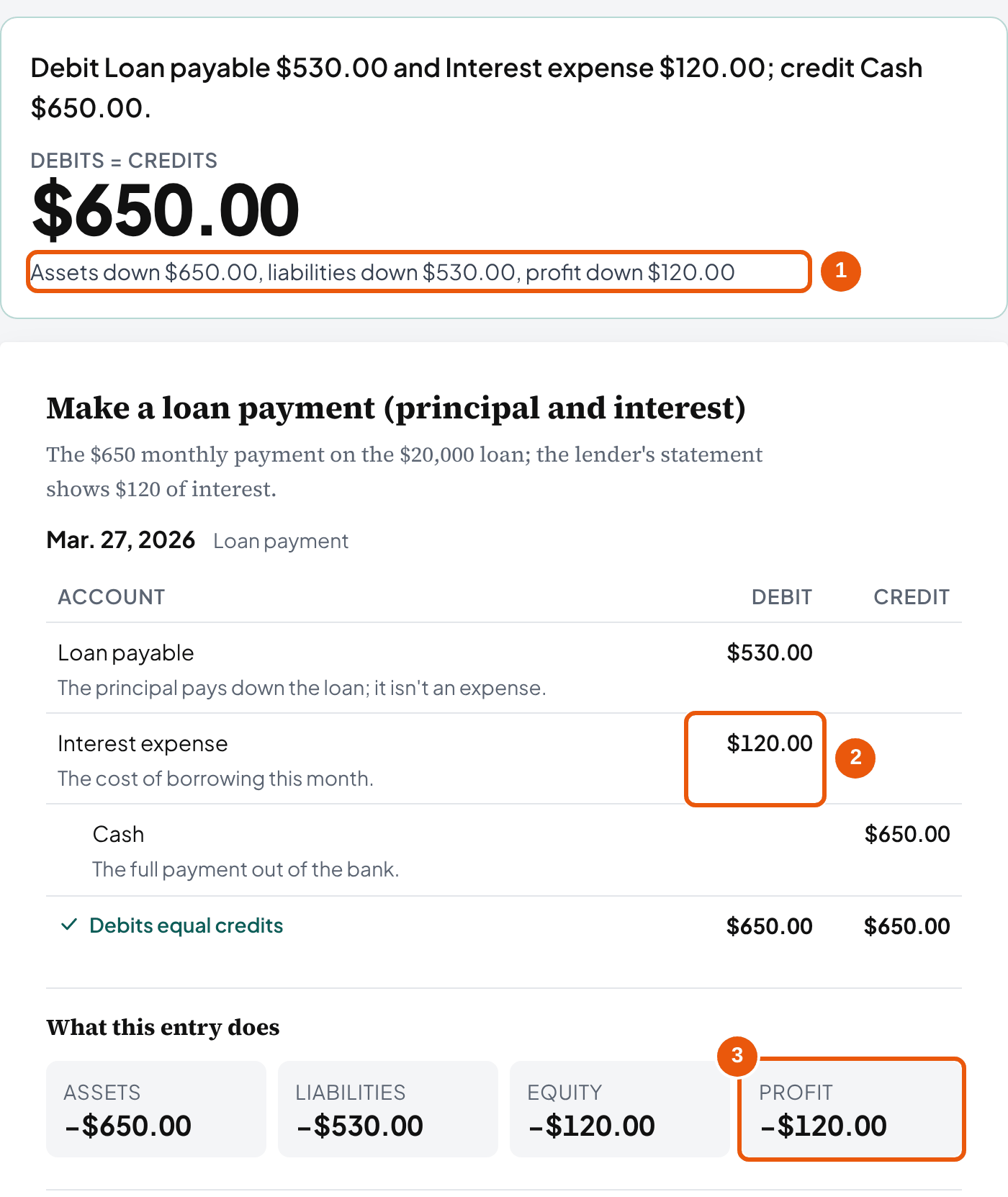
For your own amounts, pick the transaction in the tool above. It builds the entry, says why each line is there, and shows what the entry does to assets, liabilities, equity and profit. Here is the shop's loan payment:
This guide follows US practice for a small business's books. The tax figures are 2026 federal ones (IRS Publication 15), and state rules for sales tax and unemployment tax vary.
Which accounts does a debit increase, and which a credit?
In short: Debits increase assets, expenses and owner's draws. Credits increase liabilities, owner's equity and revenue. A debit decreases the accounts a credit increases, and the reverse.
| Kind of account | Examples from the coffee shop | Increased by | Decreased by |
|---|---|---|---|
| Asset | Cash, Accounts receivable, Inventory, Prepaid expenses, Equipment | Debit | Credit |
| Expense | Rent, Wages, Payroll tax, Card processing fees, Depreciation | Debit | Credit |
| Owner's draws | Owner's draws | Debit | Credit |
| Liability | Accounts payable, Credit card payable, Sales tax payable, Loan payable | Credit | Debit |
| Owner's equity | Owner's capital | Credit | Debit |
| Revenue | Sales, Catering sales | Credit | Debit |
| Contra asset | Accumulated depreciation (lowers Equipment) | Credit | Debit |
To check an entry, read each line as "up" or "down". When the shop pays its $2,000 rent, Rent expense goes up (debit) and Cash goes down (credit). When it borrows, Cash goes up (debit) and Loan payable goes up (credit). Both sides can rise together, as long as one rise is a debit and the other a credit.
Bookkeeper tip: An entry with every line on one side can't balance, and the tool flags it. A swapped entry, with the debit and credit reversed, does balance, so check each line's direction against the table above.
Seven kinds of journal entry, one March example each
The names come up in textbooks and in software menus, and every one of them is in Harbor Coffee Co's March. What makes an entry one kind rather than another is when it's posted and why, not its size:
| Kind of entry | The March entry | What makes it that kind |
|---|---|---|
| Simple | Rent, March 2: Rent expense $2,000, Cash $2,000 | One debit and one credit. |
| Compound | Payroll, March 15: six lines | Three or more lines; the debits still equal the credits. |
| Opening | Opening balances, March 1 | Posts the balance sheet a bookkeeper takes over, with capital as the balancing figure. |
| Adjusting | Depreciation, March 31 ($400) | Posted at period-end to put revenue or expense in the right month; no cash moves. |
| Reversing | The accrual reversed, April 1 | An adjusting entry with its sides swapped, dated the first day of the next period. |
| Closing | Year-end closing (example figures) | Empties revenue, expense and draws accounts into capital so the new year starts at zero. |
| Correcting | The owner's transfer, March 31 | Moves an amount from the wrong account to the right one; Cash isn't touched. |
22 journal entry examples from one coffee shop's month
In short: Harbor Coffee Co's March 2026, in date order and grouped by kind. Every amount comes from the tool above, which can load the whole month into its journal.
Opening the books on March 1
A bookkeeper who takes over books mid-year starts from the last balance sheet. Jordan enters the February 28 balances as one entry: assets as debits, liabilities and accumulated depreciation as credits, and the owner's capital as the difference that makes the two sides equal ($44,000 each).
| Account | Debit | Credit |
|---|---|---|
| Cash | $18,000.00 | |
| Inventory | $2,000.00 | |
| Equipment | $24,000.00 | |
| Accumulated depreciation | $6,000.00 | |
| Credit card payable | $1,150.00 | |
| Sales tax payable | $760.00 | |
| Federal payroll taxes payable | $730.80 | |
| FUTA tax payable | $43.20 | |
| State unemployment tax payable | $194.40 | |
| Loan payable | $20,000.00 | |
| Owner's capital | $15,121.60 | |
| Totals | $44,000.00 | $44,000.00 |
The card balance, February's sales tax and February's payroll taxes are paid in March. Each payment debits the liability, not an expense.
Paying for things
Rent is the simple entry from Publication 583, paid from the bank on March 2:
| Account | Debit | Credit |
|---|---|---|
| Rent expense | $2,000.00 | |
| Cash | $2,000.00 | |
| Totals | $2,000.00 | $2,000.00 |
Insurance for a year, paid upfront on March 3, is an asset in the books when it's paid, because the shop hasn't used the coverage yet. The month-end entry moves one month, $2,400 ÷ 12 = $200, to expense (below). When it's deducted for tax is a separate question with its own rules in Publication 334; ask the preparer.
| Account | Debit | Credit |
|---|---|---|
| Prepaid expenses | $2,400.00 | |
| Cash | $2,400.00 | |
| Totals | $2,400.00 | $2,400.00 |
The roaster's bill arrives with the beans on March 6, due in 30 days. The beans go to Inventory because the shop will sell them; the month-end count turns what was used into cost of goods sold.
| Account | Debit | Credit |
|---|---|---|
| Inventory | $2,600.00 | |
| Accounts payable | $2,600.00 | |
| Totals | $2,600.00 | $2,600.00 |
The bill is still open on March 31, so Accounts payable ends the month at $2,600. The open bill also goes on the aging list, which the accounts payable template keeps and ties to this balance.
Cups and lids on the business credit card, $310 with the sales tax the store charged. Sales tax paid on a purchase is part of what the item cost, so it isn't split out.
| Account | Debit | Credit |
|---|---|---|
| Supplies expense | $310.00 | |
| Credit card payable | $310.00 | |
| Totals | $310.00 | $310.00 |
Small cash purchases from a petty cash box are posted the same way but in one entry when the box is topped up: each slip's expense debited, Cash credited for the check (the petty cash log template keeps the slips and totals them).
Paying the card statement on March 25 clears February's balance. The purchases on it were expensed when they were charged, so this entry only lowers the liability:
| Account | Debit | Credit |
|---|---|---|
| Credit card payable | $1,150.00 | |
| Cash | $1,150.00 | |
| Totals | $1,150.00 | $1,150.00 |
Sales and money coming in
Card sales arrive net of the processor's fee. Customers paid $5,184 by card from March 1 to 15 ($4,800 of sales plus $384 of sales tax). The processor kept $156 and deposited $5,028 on March 16. The entry books all four amounts:
| Cash | $5,028.00 | |
| Card processing fees | $156.00 | |
| Sales | $4,800.00 | |
| Sales tax payable | $384.00 |
Debits $5,184.00 = credits $5,184.00
| Account | Debit | Credit |
|---|---|---|
| Cash | $5,028.00 | |
| Card processing fees | $156.00 | |
| Sales | $4,800.00 | |
| Sales tax payable | $384.00 | |
| Totals | $5,184.00 | $5,184.00 |
The reason to book the gross is on the form the processor files. The Instructions for Form 1099-K define box 1a as the total "without regard to any adjustments for credits, cash equivalents, discount amounts, fees, refunded amounts, shipping amounts, or any other amounts." The form also shows each month's gross in boxes 5a through 5l. Harbor's card charges for March come to $10,800, while the two deposits add up to $10,476. Books built from the deposits would be $324 short of March's figure on the year's 1099-K, the exact amount of the fees.
A card processor sends the form "no matter how many payments you got or how much they were for," the IRS says. The over-$20,000 and over-200-transactions threshold is for payment apps and online marketplaces.
| Account | Debit | Credit |
|---|---|---|
| Cash | $5,448.00 | |
| Card processing fees | $168.00 | |
| Sales | $5,200.00 | |
| Sales tax payable | $416.00 | |
| Totals | $5,616.00 | $5,616.00 |
The second payout covers March 16 to 31. In our example the processor pays out twice a month; check the client's payout report for the actual dates and fees.
An invoice for a catering order on March 10 bills an office event held that day. On the accrual method it's income once it's earned, at the event, and a receivable until it's paid. Catering is taxable in some states; in our example it isn't taxed, so check the client's state.
| Account | Debit | Credit |
|---|---|---|
| Accounts receivable | $2,000.00 | |
| Catering sales | $2,000.00 | |
| Totals | $2,000.00 | $2,000.00 |
| Account | Debit | Credit |
|---|---|---|
| Cash | $2,000.00 | |
| Accounts receivable | $2,000.00 | |
| Totals | $2,000.00 | $2,000.00 |
The payment on March 20 only swaps one asset for another. Crediting Catering sales again would count the order twice.
Payroll and tax payments
Payroll is recorded from the payroll provider's report. Two part-time baristas earn $900 each per payroll, $1,800 in all. For 2026, Social Security is 6.2% for the employee and 6.2% for the employer, and Medicare is 1.45% each (IRS Publication 15). The federal income tax withheld, $90, comes from the report; it depends on each employee's W-4.
| Employee Social Security: $1,800 × 6.2% | $111.60 |
| Employee Medicare: $1,800 × 1.45% | $26.10 |
| Net pay: $1,800 − $111.60 − $26.10 − $90 withheld | $1,572.30 |
| Federal payroll taxes payable: $90 + $111.60 × 2 + $26.10 × 2 | $365.40 |
| FUTA: $1,800 × 0.6% | $10.80 |
| State unemployment: $1,800 × 2.7% (our assumption) | $48.60 |
| Employer's payroll tax expense: $111.60 + $26.10 + $10.80 + $48.60 | $197.10 |
Debits: $1,800 of wages + $197.10 of payroll tax = $1,997.10. Credits: $1,572.30 + $365.40 + $10.80 + $48.60 = $1,997.10.
| Account | Debit | Credit |
|---|---|---|
| Wages expense | $1,800.00 | |
| Payroll tax expense | $197.10 | |
| Cash | $1,572.30 | |
| Federal payroll taxes payable | $365.40 | |
| FUTA tax payable | $10.80 | |
| State unemployment tax payable | $48.60 | |
| Totals | $1,997.10 | $1,997.10 |
FUTA is 6.0% on each employee's first $7,000 of wages for the year, and "if you're entitled to the maximum 5.4% credit, the FUTA tax rate after credit is 0.6%" (Publication 15). Each barista has earned $5,400 by March 31, so all of March's wages count. In the payroll that takes an employee past $7,000, only the part up to $7,000 is FUTA wages; the tool has a field for it. The 2.7% state unemployment rate is our assumption: each state sets its own rates and wage base.
Additional Medicare Tax doesn't show up here. Publication 15: "Additional Medicare Tax is only imposed on the employee. There is no employer share of Additional Medicare Tax." The employer withholds it only on an employee's wages over $200,000.
The payroll tax deposit on March 13 sends February's withholding and both halves of Social Security and Medicare to the IRS. A monthly schedule depositor deposits a month's taxes "by the 15th day of the following month." The deposit clears the liability; the expense was recorded with each payroll.
| Account | Debit | Credit |
|---|---|---|
| Federal payroll taxes payable | $730.80 | |
| Cash | $730.80 | |
| Totals | $730.80 | $730.80 |
The sales tax return for February is paid the same day. Collected tax was never Harbor's money, so paying it is not an expense:
| Account | Debit | Credit |
|---|---|---|
| Sales tax payable | $760.00 | |
| Cash | $760.00 | |
| Totals | $760.00 | $760.00 |
Where a state imposes the tax on the seller instead, it's part of gross receipts and deductible: see Is sales tax an expense?
The second payroll on March 31 is the same entry as the first, $1,800 of wages and $1,572.30 of net pay, so we don't repeat it here. Load the month into the tool to see it in the journal. Harbor pays on the last day of the month, so nothing is owed to the baristas at March 31; when a pay period ends in one month and the paycheck lands in the next, the wages are accrued at month-end, and the accrued payroll journal entry tool builds that entry and its reversal from the pay period dates.
The loan and the owner
The loan payment is $650 a month, and the lender's statement shows $120 of interest. Only the interest is a cost; the other $530 pays back money the business borrowed, and borrowing was never income either. Publication 334: "Money borrowed through a bona fide loan is not income."
| Account | Debit | Credit |
|---|---|---|
| Loan payable | $530.00 | |
| Interest expense | $120.00 | |
| Cash | $650.00 | |
| Totals | $650.00 | $650.00 |
The owner's draw of $1,500 on March 28 isn't wages and isn't an expense. The Schedule C instructions say not to include "amounts paid to yourself" on the wages line. It lowers the owner's equity, and the owner is taxed on the shop's profit, however much she draws (how owner draws are taxed).
| Account | Debit | Credit |
|---|---|---|
| Owner's draws | $1,500.00 | |
| Cash | $1,500.00 | |
| Totals | $1,500.00 | $1,500.00 |
Month-end adjustments
Adjusting entries put revenue and expenses in the month they belong to, which is why the books need them even when no cash moves. Jordan posts four on March 31.
One month of insurance used up: $2,400 ÷ 12 months = $200. The books spread the cost over the months the policy covers, whatever the tax return does with it.
| Account | Debit | Credit |
|---|---|---|
| Insurance expense | $200.00 | |
| Prepaid expenses | $200.00 | |
| Totals | $200.00 | $200.00 |
Depreciation on the shop's $24,000 of equipment, straight line over 5 years: $24,000 ÷ 60 months = $400 a month. The 5-year life is our assumption for the books. Tax depreciation follows IRS Publication 946 and the preparer's elections, and can be a different number. Land is never depreciated, because it "does not wear out, become obsolete, or get used up" (Publication 946).
| Account | Debit | Credit |
|---|---|---|
| Depreciation expense | $400.00 | |
| Accumulated depreciation | $400.00 | |
| Totals | $400.00 | $400.00 |
March's electricity, about $420, won't be billed until April 8. Accruing it charges it to March. The reversing entry on April 1 takes it back out, so the April bill can be entered normally without counting March's electricity a second time, in April:
| Account | Debit | Credit |
|---|---|---|
| Utilities expense | $420.00 | |
| Accrued expenses | $420.00 | |
| Totals | $420.00 | $420.00 |
| Account | Debit | Credit |
|---|---|---|
| Accrued expenses | $420.00 | |
| Utilities expense | $420.00 | |
| Totals | $420.00 | $420.00 |
A reversing entry is the original with debits and credits swapped, dated the first day of the next month. It isn't the original entry again.
Cost of goods sold from the count. The beans and milk on hand were $2,000 at March 1, the shop bought $2,600, and the count on March 31 came to $1,700 at cost. So $2,000 + $2,600 − $1,700 = $2,900 was used or sold.
| Account | Debit | Credit |
|---|---|---|
| Cost of goods sold | $2,900.00 | |
| Inventory | $2,900.00 | |
| Totals | $2,900.00 | $2,900.00 |
Publication 334 lets a small business taxpayer choose not to keep an inventory, but the method must still "clearly reflect income". Agree the method with the client's tax preparer.
Fixing a mistake
On March 24 the owner moved $1,000 of her own money into the business account. The bank feed rule for deposits categorized it as a sale:
| Account | Debit | Credit |
|---|---|---|
| Cash | $1,000.00 | |
| Sales | $1,000.00 | |
| Totals | $1,000.00 | $1,000.00 |
Cash is right; only the credit is wrong. The correcting entry on March 31 takes the $1,000 out of Sales and puts it in Owner's capital, without touching Cash. Left alone, it would have added $1,000 of profit the shop never earned.
| Account | Debit | Credit |
|---|---|---|
| Sales | $1,000.00 | |
| Owner's capital | $1,000.00 | |
| Totals | $1,000.00 | $1,000.00 |
Does it balance? The coffee shop's trial balance for March
In short: Yes: after 22 entries, debits and credits both total $59,208.80. March's profit is $1,331.80, while cash rose $1,140.60.
| Account | Debit | Credit |
|---|---|---|
| Cash | $19,140.60 | |
| Inventory | $1,700.00 | |
| Prepaid expenses | $2,200.00 | |
| Equipment | $24,000.00 | |
| Accumulated depreciation | $6,400.00 | |
| Accounts payable | $2,600.00 | |
| Credit card payable | $310.00 | |
| Sales tax payable | $800.00 | |
| Federal payroll taxes payable | $730.80 | |
| FUTA tax payable | $64.80 | |
| State unemployment tax payable | $291.60 | |
| Accrued expenses | $420.00 | |
| Loan payable | $19,470.00 | |
| Owner's capital | $16,121.60 | |
| Owner's draws | $1,500.00 | |
| Sales | $10,000.00 | |
| Catering sales | $2,000.00 | |
| Cost of goods sold | $2,900.00 | |
| Rent expense | $2,000.00 | |
| Wages expense | $3,600.00 | |
| Payroll tax expense | $394.20 | |
| Card processing fees | $324.00 | |
| Supplies expense | $310.00 | |
| Insurance expense | $200.00 | |
| Utilities expense | $420.00 | |
| Interest expense | $120.00 | |
| Depreciation expense | $400.00 | |
| Totals | $59,208.80 | $59,208.80 |
A trial balance that ties proves total debits equal total credits. It doesn't prove the accounts are right: the $1,000 transfer booked as a sale balanced too. That's why the bank reconciliation, the sales tax return and the payroll reports still get compared with the balances before the month is closed. The balance sheet reconciliation template records those comparisons account by account, with the statement or report balance next to the book balance.
The profit is $12,000 of revenue ($10,000 of sales and $2,000 of catering) less $10,668.20 of expenses. In March the two moved apart by $191.20, and a client who sees a profit figure and a smaller rise in the bank balance will ask why. The table below walks from one to the other, using only the month's entries:
| Profit for March | $1,331.80 |
| Depreciation (an expense with no cash out) | +$400.00 |
| Electricity accrued, not paid yet | +$420.00 |
| Roaster's bill, not paid yet | +$2,600.00 |
| Inventory on hand down from $2,000 to $1,700 | +$300.00 |
| More sales and payroll tax owed at month-end | +$158.80 |
| Insurance paid for the next 11 months | −$2,200.00 |
| Credit card paid down | −$840.00 |
| Loan principal repaid | −$530.00 |
| Owner's draw | −$1,500.00 |
| Owner's own money put in | +$1,000.00 |
| Change in cash ($18,000.00 to $19,140.60) | +$1,140.60 |
Use the table to explain the gap to the client. The shop made $1,331.80, the owner took $1,500 and put $1,000 back, a year of insurance went out at once, and the roaster won't be paid until April.
Which journal entries do bank feeds get wrong?
In short: The ones where the bank sees one amount and the books need two or more: net card payouts, loan payments, payroll, card payments and the owner's own money.
A bank feed records what moved through the account, and a rule assigns each amount to one account. That works for rent. It fails wherever the bank amount is a net figure or the second half of something already recorded. Here is each case in Harbor's March, with what the shortcut does to the numbers:
| What the feed does | The entry that's right | What the shortcut costs |
|---|---|---|
| Records the $5,028 card deposit as sales | Sales $4,800, sales tax $384, fees $156, cash $5,028 | Sales overstated by $228 (tax inside sales, fees netted out); this payout $156 short of the 1099-K's gross ($324 for the month) |
| Sends the whole $650 loan payment to an expense | Loan payable $530, interest $120 | Expenses $530 too high and the loan balance $530 too high |
| Records the $1,572.30 of net pay as wages | Wages $1,800, payroll tax $197.10, and the liabilities | Wages $227.70 short and $197.10 of employer tax missing per payroll |
| Expenses the $1,150 credit card payment | Credit card payable $1,150 | February's purchases expensed a second time |
| Books the owner's $1,000 transfer as a sale | Owner's capital $1,000 | $1,000 of profit that wasn't earned |
Each fix is a correcting entry like the one above, or an edit to the feed rule so next month starts right. The tool's "Fix a wrong category" option builds the correcting entry from the amount, the wrong account and the right one.
Bookkeeper tip: Before closing a month, compare Sales tax payable with the return, Federal payroll taxes payable with the payroll report, and the loan balance with the lender's statement. When one is off, check the difference against the amounts in this table first: a loan balance $530 too high is one payment booked as an expense, and a payroll liability $365.40 short is one payroll booked from the bank.
How do closing entries work at year-end?
In short: Revenue accounts are debited and expense accounts credited to bring them to zero, the profit moves to the owner's capital, and draws are closed to capital.
Closing entries run the opposite way to each account's normal balance: revenue, which built up as credits, is debited to empty it. Take a sole proprietor with $150,000 of revenue, $132,000 of expenses and $18,000 of draws for the year (example figures, not Harbor's):
| Account | Debit | Credit |
|---|---|---|
| Revenue accounts (each one) | $150,000.00 | |
| Income summary | $150,000.00 | |
| Totals | $150,000.00 | $150,000.00 |
| Account | Debit | Credit |
|---|---|---|
| Income summary | $132,000.00 | |
| Expense accounts (each one) | $132,000.00 | |
| Totals | $132,000.00 | $132,000.00 |
| Account | Debit | Credit |
|---|---|---|
| Income summary | $18,000.00 | |
| Owner's capital | $18,000.00 | |
| Totals | $18,000.00 | $18,000.00 |
| Account | Debit | Credit |
|---|---|---|
| Owner's capital | $18,000.00 | |
| Owner's draws | $18,000.00 | |
| Totals | $18,000.00 | $18,000.00 |
After the four entries, Income summary is back to zero and the owner's capital has gone up by $18,000 of profit and down by $18,000 of draws. In a partnership the profit goes to each partner's capital account under the agreement; in a corporation, to retained earnings. If the client's software rolls the year over on its own, these entries show what it did, which helps when a retained earnings or capital balance looks wrong.
Should equipment be expensed or capitalized?
In short: Capitalize it and depreciate it, unless the client elects the de minimis safe harbor and the item costs $2,500 or less per item or invoice.
Since 2016 (IRS Notice 2015-82), the de minimis threshold has been "$2500 per invoice or item for taxpayers without applicable financial statements", the IRS's tangible property page says ($5,000 with one, per Publication 334). The election is made with a statement attached to a timely filed return, and the books have to expense the item too. It "does not include amounts paid for inventory and land."
Items above the limit are capitalized in the books; tax depreciation, including any first-year deduction, follows the preparer's elections (Publication 946). A $2,484 grinder ($2,300 plus $184 of sales tax) fits under the limit; a $2,592 espresso machine doesn't. Both come from our sales tax article, which explains why the tax counts toward the cost. In the tool, "Buy equipment" asks whether the client uses the safe harbor and picks the account from the answer.
How do you get these entries into QuickBooks Online or a spreadsheet?
In short: Type them in the journal entry screen, or import a CSV. Intuit's help page describes an import with the columns the tool's CSV uses.
Intuit's "Import journal entries" page (updated August 2026) lists the columns as Journal No., Journal Date, Account Name, Journal/Description, Debits and Credits, and the path as Settings, then Import Data, then Journal Entries. Its notes matter more than the steps:
- "Turn off account numbers before you begin." You can turn them back on after the import.
- Sub-accounts need the parent: "Parent account: Sub Account". A sub-account name alone causes a "Line Account Invalid" error.
- Lines that use Accounts payable or Accounts receivable need the Name column filled in with the vendor or customer.
- New accounts must be in the chart of accounts before the import.
Older answers in the QuickBooks Community, three or four years old, say the import wasn't available in the US; the current help page says it is. Import one entry into the client's file first and check it before you import a month.
A spreadsheet is a fine journal too. IRS Topic 305 says "there's not a required method of bookkeeping you must use. However, you must use a method that clearly and accurately reflects your gross income and expenses." Publication 583 adds that with a computerized system you must be able to produce legible records that support the entries on the return. The CSV from the tool opens in Excel or Google Sheets with one row per line.
Employment tax records are kept "for at least 4 years after the tax becomes due or is paid, whichever is later" (IRS Topic 305). Keep the payroll reports behind each payroll entry.
Common journal entry mistakes
In short: Each one on this list is an amount on the wrong side, an amount booked net when the records need the gross, or the second half of a transaction booked as if it were the first.
- Writing closing entries backwards. Revenue is debited to close it, and the income summary is credited.
- Calling the accrual itself a reversing entry. The reversal is the accrual with sides swapped, on the first day of the next month.
- One-sided entries. A debit with no credit can't post. If an example shows a single line, it's missing half the entry.
- Booking deposits instead of sales. Net payouts hide the fees and leave the books short of the 1099-K.
- Payroll from the bank only. Net pay isn't the wage expense, and the employer's taxes and the liabilities go missing.
- Expensing a payment of something already recorded: card statements, vendor bills, payroll tax deposits and sales tax returns.
- Leaving the owner's money in sales, or a draw in wages.
Each one is a transaction type in the tool, with the entry that's right and a note on what goes wrong.
Frequently asked questions
What is a simple journal entry?
A journal entry with one debit and one credit for the same amount. Paying $2,000 of rent from the bank is one: debit Rent expense $2,000, credit Cash $2,000. IRS Publication 583 shows the same shape with $780 of rent paid on October 5. An entry with three or more lines, such as a payroll or a card payout net of fees, is called a compound entry.
What are the rules for debits and credits?
A debit increases assets, expenses and owner's draws; a credit increases liabilities, owner's equity and revenue. Each does the opposite to the other side. Every entry needs equal debits and credits, so a payment that lowers Cash (a credit) is always matched by a debit: an expense or another asset goes up, or a liability goes down.
How do you record a payment that comes in net of card processing fees?
Record the sales and sales tax at the full amount the customers paid, the processor's fee as an expense, and the deposit to Cash. Harbor Coffee Co's March 1–15 payout: debit Cash $5,028 and Card processing fees $156; credit Sales $4,800 and Sales tax payable $384. Form 1099-K reports the gross amount before fees, so booking only the deposit leaves the books short of the form.
What is the journal entry for a loan payment?
Split it using the lender's statement: debit Loan payable for the principal, debit Interest expense for the interest, and credit Cash for the full payment. A $650 payment with $120 of interest is a $530 debit to Loan payable and a $120 debit to Interest expense. The principal isn't an expense; it only lowers what the business owes.
How do you record payroll in a journal entry?
From the payroll report: debit Wages expense for gross pay and Payroll tax expense for the employer's taxes; credit Cash for net pay and a liability for every tax withheld or owed. For $1,800 of 2026 wages with $90 of income tax withheld, net pay is $1,572.30, the federal liability is $365.40 (withholding plus both halves of Social Security and Medicare), and the employer's taxes come to $197.10 with our 2.7% state unemployment assumption.
Is an owner's draw an expense?
No. A draw is recorded as a debit to Owner's draws, an equity account, and a credit to Cash. It doesn't lower profit, and the Schedule C instructions say not to include amounts paid to yourself in wages. The owner of a sole proprietorship or single-member LLC is taxed on the profit, whatever they draw.
What is the difference between an adjusting entry and a reversing entry?
An adjusting entry at month-end puts revenue or expense in the right month, such as accruing March's $420 electricity bill that arrives in April. A reversing entry is the same entry with debits and credits swapped, dated the first day of the next month, so that when the real bill is recorded as an expense in April, March's electricity isn't counted a second time.
What are closing entries and which way do they go?
At year-end, revenue accounts are debited and expense accounts credited to bring them to zero, with the other side in Income summary. Income summary is then closed to the owner's capital (credit for a profit), and draws are closed to capital (debit capital, credit draws). If the client's software rolls the year over on its own, these are the entries it makes.
How do I fix a transaction the bank feed put in the wrong account?
Edit the transaction if the period is open. If it's closed, post a correcting entry that moves the amount from the wrong account to the right one without touching Cash. When the owner's $1,000 transfer was booked as a sale, the correction is a debit to Sales and a credit to Owner's capital, both $1,000.
Can I import journal entries into QuickBooks Online from a spreadsheet?
Intuit's help page (updated August 2026) describes importing journal entries from a CSV file through Settings, Import Data, Journal Entries, with columns for journal number, date, account name, description, debits and credits, and a name for Accounts payable or receivable lines. It says to turn off account numbers first and to write sub-accounts as Parent account: Sub account. Test with one entry in the client's file before importing a month.
Does the IRS require double-entry bookkeeping?
No. IRS Topic 305 says there's no required method of bookkeeping, but the method must clearly and accurately reflect gross income and expenses. Publication 583 describes both single-entry and double-entry systems and notes that double entry is self-balancing, because total debits must equal total credits.
How we built this page
Ledgental Team built the tool and wrote this guide. Ledgental also makes a bookkeeping app that's free during its beta; this page doesn't sell it, and the tool works without an account.
What the entries rest on
- Debits and credits follow standard double-entry practice, as IRS Publication 583 describes it. The closing entries follow the textbook method in OpenStax's Principles of Accounting, section 5.1 (revenue closed to Income Summary first), which we link to rather than copy.
- Tax rules and rates were read word for word on the IRS pages listed under Sources on October 4, 2026: 2026 payroll rates in Publication 15, Form 1099-K's gross amount, Publication 334 on loans, sales tax, prepaid expenses and inventory, the Schedule C instructions on owner pay, and the de minimis safe harbor.
- The QuickBooks Online import is described from Intuit's help page as it read on October 4, 2026. We haven't run an import in a live account, so test one entry first.
What's our assumption
- Harbor Coffee Co, Jordan Miles and Northline Bookkeeping are fictional, and so are every balance and amount in the month.
- The 2.7% state unemployment rate, the $90 of income tax withheld, the 5-year book life of the equipment, the processor's twice-monthly payouts and fees, and the year-end figures in the closing example are our assumptions.
- The chart of accounts is a common small-business layout. Use the client's own account names.
How the numbers are checked
One engine builds every entry in the tool and in this guide, so the two can't drift apart. Automated tests check that every entry balances, recompute the payroll, depreciation and inventory figures by hand, and confirm the March trial balance ties at $59,208.80 and the profit-to-cash walk adds up to $1,140.60.
Cite this page
Writing about this? Use one of these lines. To point at one section, use the link icon beside its heading.
- Plain line
- Ledgental, Journal Entry Examples, updated October 2026, https://ledgental.com/tools/journal-entry-examples
- APA
- Ledgental. (2026, October). Journal Entry Examples. https://ledgental.com/tools/journal-entry-examples
- Chicago
- Ledgental. “Journal Entry Examples.” Last modified October 2026. https://ledgental.com/tools/journal-entry-examples.
Reusing this page: the guide's text, entries, and diagrams are licensed under CC BY 4.0. Credit "Ledgental" with a link to this page. Quotations from the IRS are public domain, and quotations from Intuit stay under Intuit's terms.
Sources
- Publication 583 (12/2024), Starting a Business and Keeping Records, Internal Revenue Service
- Topic no. 305, Recordkeeping, Internal Revenue Service
- Publication 15 (2026), (Circular E), Employer's Tax Guide, Internal Revenue Service
- Instructions for Form 1099-K (12/2026), Internal Revenue Service
- Understanding your Form 1099-K, Internal Revenue Service
- Publication 334 (2025), Tax Guide for Small Business, Internal Revenue Service
- Instructions for Schedule C (Form 1040) (2025), Internal Revenue Service
- Tangible property final regulations, Internal Revenue Service
- Publication 946 (2025), How To Depreciate Property, Internal Revenue Service
- Import journal entries (QuickBooks Online), Intuit
- Principles of Accounting, Volume 1, 5.1 Describe and Prepare Closing Entries for a Business, OpenStax, Rice University (CC BY-NC-SA 4.0)
General information about US bookkeeping, not tax, legal, or accounting advice. Ledgental isn't a CPA firm and isn't affiliated with the IRS or Intuit. Rules and 2026 rates were checked at the IRS in October 2026 and change every year. Harbor Coffee Co, Jordan Miles, and Northline Bookkeeping are fictional, and the amounts are examples. Check payroll and tax figures against the client's own reports and with their tax preparer.